THE STATISTICS
Federal survey data, peer-reviewed research, and the numbers no one talks about.
Everything on this page is sourced. Nothing is exaggerated. The truth is enough.
Domestic violence against men is not a fringe claim. It is documented by the same federal agencies and peer-reviewed researchers that produce the data used to fund shelters, train police, and write legislation for female victims.
The problem is not a lack of data. The problem is which data gets cited — and which gets ignored.
This page presents the findings from the two primary federal surveys on intimate partner violence (IPV), alongside peer-reviewed studies on male victimization, help-seeking, and system response. Every statistic includes its source. We encourage journalists, lawmakers, researchers, and service providers to verify every number on this page.
All data comes from our full list of References. If you want to follow up with us directly, go to the Contact page.
WHY THE NUMBERS VARY
Two Federal Surveys, Two Different Stories
The United States runs two major federal surveys that measure intimate partner violence. They produce dramatically different results — not because one is wrong, but because they ask the question differently.
The National Crime Victimization Survey (NCVS), run by the Bureau of Justice Statistics (DOJ), asks: “Were you a victim of [crime type]?” The respondent must identify their experience as a crime. It measures criminal victimization.
The National Intimate Partner and Sexual Violence Survey (NISVS), run by the Centers for Disease Control (HHS), asks: “Did a partner ever [specific behavior]?” It asks about behaviors — hitting, pushing, shoving, controlling — regardless of whether the respondent labels it a crime. It measures violence as a public health issue.
This distinction matters enormously for male victims.
When the NCVS asks men “were you a victim of a crime?”, most say no — even when they’ve been hit, controlled, or sexually coerced. Men are socialized not to see themselves as victims, especially of a female partner. The result: men account for only 15% of IPV victims in the NCVS (Bureau of Justice Statistics, 2019–2024).
When the NISVS asks men “did a partner ever hit, push, shove, or slam you?”, the picture changes completely. Men report physical violence at virtually identical rates to women — 42.3% vs. 42.0% (Leemis et al., 2022).
The gap is not in the violence. It’s in whether the victim labels it a crime.
NCVS vs. NISVS: SIDE BY SIDE
Survey Design
| NCVS | NISVS | |
|---|---|---|
| Agency | Bureau of Justice Statistics (DOJ) | Centers for Disease Control (HHS) |
| Purpose | Measure criminal victimization | Measure violence as a public health issue |
| How it asks | “Were you a victim of [crime type]?” | “Did a partner ever [specific behavior]?” |
| Sample size | ~240,000 persons/year | ~27,500 adults (2016/2017) |
| Interview method | In-person and phone, often with household members present | Phone, private interview |
| Time frame | Prior 6 months (annualized) | Lifetime and past 12 months |
What the Data Shows
| Measure | Male | Female | Male Share |
|---|---|---|---|
| NCVS: IPV victimizations (2019–2024 total) | 603,949 | 3,419,858 | 15.0% |
| NCVS: IPV victimizations, 2024 only | 173,548 | 609,355 | 22.2% |
| NISVS: Any physical violence by partner (lifetime) | 42.3% (49.9M) | 42.0% (52M) | Nearly equal |
| NISVS: Severe physical violence by partner (lifetime) | 24.6% (29M) | 32.5% (40.5M) | ~1 in 4 vs. ~1 in 3 |
| NISVS: Any contact sexual violence, physical violence, and/or stalking (lifetime) | 44.2% (52.1M) | 47.3% (59M) | Nearly equal |
| NISVS: Psychological aggression by partner (lifetime) | 45.1% (53.3M) | 49.4% (61.7M) | Nearly equal |
Sources: Bureau of Justice Statistics, NCVS 2019–2024; Leemis et al., 2022 (NISVS 2016/2017)
The measurement method determines the result.
When you ask men “were you a victim?”, they say no. When you ask “did she hit you?”, nearly half say yes.
The number changes based on what you count. The men don’t.
BREAKING THE MYTH
The prevalence of intimate partner violence against men depends on the definition used. As the definition narrows, the number shrinks — but every number represents millions of men.
1 in 2 Men
Experienced psychological aggression by a partner. This is the most pervasive form of abuse, often involving systematic control, humiliation, and entrapment. Approximately 45–49% of men report experiencing psychological aggression by an intimate partner in their lifetime (Leemis et al., 2022; Black et al., 2011). In help-seeking populations, 96% experienced severe psychological aggression (Hines & Douglas, 2016).
1 in 3 Men
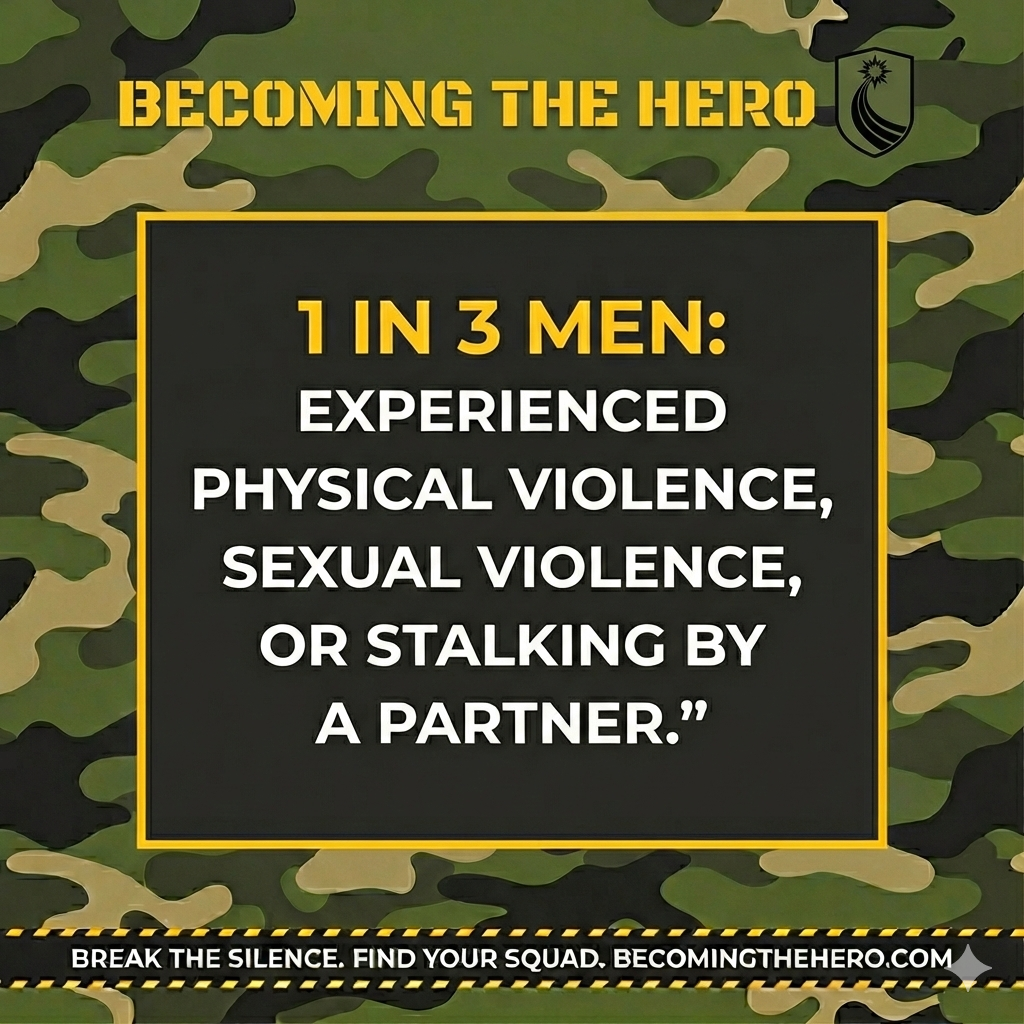
Experienced physical violence, sexual violence, or stalking by a partner. This is the broadest physical measure. Approximately 33–44% of men report experiencing contact sexual violence, physical violence, and/or stalking by an intimate partner in their lifetime, depending on the survey year (Leemis et al., 2022; Black et al., 2011).
1 in 4 Men
Experienced IPV with a reported impact. About 26% of men experienced contact sexual violence, physical violence, or stalking by a partner and reported a related impact such as fear, concern for safety, injury, PTSD symptoms, missed work, or need for medical care (Leemis et al., 2022).
1 in 7 Men
Experienced severe physical violence. Approximately 13.8% of men aged 18 and older have been the victim of severe physical violence by an intimate partner — including being beaten, burned, choked, or attacked with a weapon (Black et al., 2011).
1 in 10 Men
Experienced IPV with PTSD or long-term clinical impact. Approximately 10% of men experienced contact sexual violence, physical violence, and/or stalking by a partner and reported long-term impacts including PTSD symptoms, injury requiring medical care, or significant disruption to daily life (Leemis et al., 2022).male partners. If any of these have happened to you, it is not your fault, and it is not something to minimize or dismiss.
All data: CDC National Intimate Partner and Sexual Violence Survey (NISVS)
THE SERVICE GAP
The Service Gap: Who Gets Help and Who Doesn’t
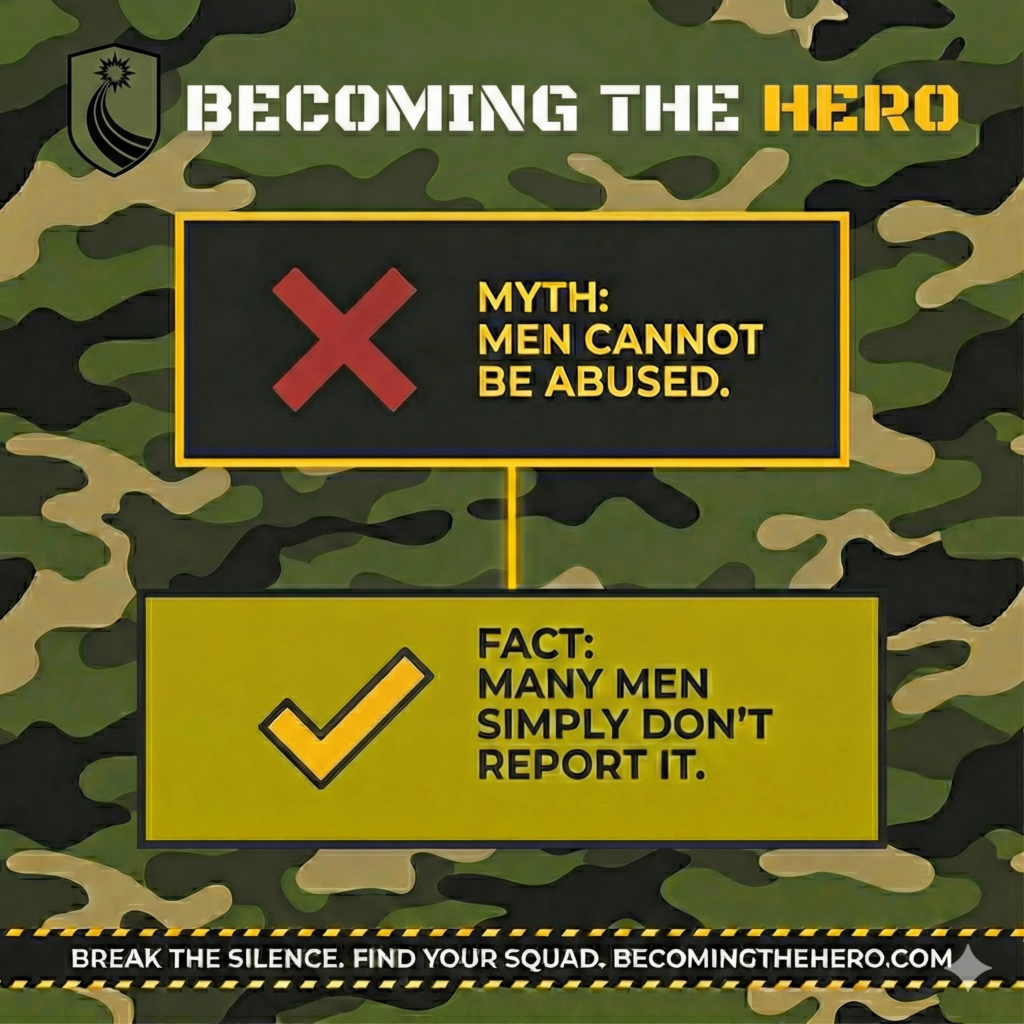
Male victims experience violence at rates comparable to female victims. They do not receive services at rates even close to comparable.
The Shelter Gap
There are approximately 2,000 domestic violence agencies and hotlines in the United States. As of 2025, only two shelters in the entire country are dedicated specifically to male victims (Hines, Lysova, & Douglas, 2025).
In the United Kingdom, 37 organizations provide dedicated shelter spots for men — offering a total of 40 spaces (Hines, Lysova, & Douglas, 2025).
In Northern Ireland, there are zero domestic abuse shelters for men (Commissioner for Victims of Crime Northern Ireland, 2024).
In Canada, the first dedicated shelter for male DV victims opened in 2021 (Hines, Lysova, & Douglas, 2025).
Service Utilization: Men vs. Women
| Service | Male Survivors | Female Survivors |
|---|---|---|
| No interaction with any services | 26% | 10% |
| DV shelters | 5% | 26% |
| Victim assistance services | 9% | 41% |
| Healthcare services for abuse | 7% | 43% |
| Mental health services | 28% | 47% |
Source: Roebuck, Pathe, & Frkovic, 2020
Federal Survey Data on Service Access
| Measure | Male Victims | Female Victims | Disparity |
|---|---|---|---|
| Received any victim services (NCVS) | 9.8% | 25.9% | 2.6x gap |
| Needed victim advocate services (NISVS) | 0.6% (701K) | 6.0% (7.5M) | 10x gap |
| Contacted crisis hotline (NISVS) | 1.5% (1.8M) | 6.1% (7.6M) | 4.1x gap |
| Needed housing services (NISVS) | 1.4% (1.6M) | 5.5% (6.9M) | 3.9x gap |
Sources: Bureau of Justice Statistics, NCVS 2019–2024; Leemis et al., 2022 (NISVS 2016/2017)
Only 9.8% of male IPV victims received any form of victim services — meaning 90% of male victims received no help at all (Bureau of Justice Statistics, 2019–2024).
Over 52 million men in the United States have experienced intimate partner violence in their lifetime. There are two shelters dedicated to serving them.
HOTLINE AND AGENCY OUTCOMES
Men do seek help. The system is not designed to help them back.
DV Hotlines and Agencies
When men contact mainstream domestic violence services, the response is frequently rejection, disbelief, or misidentification as the perpetrator.
- 63.9% of men who contacted DV hotlines were told “we only help women” (Douglas & Hines, 2011).
- 49.9% of men who contacted DV agencies were told the same (Douglas & Hines, 2011).
- 40.2% of men seeking help from DV agencies were accused of being the batterer (Douglas & Hines, 2011).
- 32.2% of men contacting hotlines were accused of being the batterer (Douglas & Hines, 2011).
- Over 25% of men using online DV resources were given a phone number that turned out to be a batterer’s intervention program (Douglas & Hines, 2011).
- 16.4% of men contacting hotlines reported being ridiculed by staff (Douglas & Hines, 2011).
- ~67% of men rated DV agencies and hotlines as “not at all helpful” (Douglas & Hines, 2011).
Men reported significantly more positive experiences when accessing agencies specifically designed for male victims (average helpfulness 3.23/5) compared to mainstream agencies (2.68/5) (Hines, Lysova, & Douglas, 2025).
Mental Health Professionals: The Exception
Unlike DV agencies, mental health professionals are consistently rated as helpful by male victims.
- 66.2% of help-seeking men sought help from a mental health professional, making it one of the most utilized formal resources (Douglas & Hines, 2011).
- 70.6% of men found mental health professionals “somewhat” or “very” helpful (Douglas & Hines, 2011).
- 68% of men reported that mental health professionals took their concerns seriously (Douglas & Hines, 2011).
The data is clear: the DV-specific infrastructure fails men. Generalist mental health professionals do not.
THE CRIMINAL JUSTICE RESPONSE
Police and Legal System Data
Male victims report to police at nearly the same rate as female victims — 49.4% vs. 53.8% (Bureau of Justice Statistics, 2019–2024). This counters the narrative that men simply don’t seek help. They do reach out to the system. The system does not reach back.
Police Response
- ~40% of men who called police reported that the police “did nothing” (Douglas & Hines, 2011).
- 25.4% reported being ignored or dismissed by police (Douglas & Hines, 2011).
- 25% of men who called police for help were arrested themselves (Hall, 2016).
- 64% of male survivors who called police in a Canadian study reported being treated as the abuser (Dutton, 2012 cited in Roebuck, Pathe, & Frkovic, 2020).
- Male victims are 37 times more likely to be charged than female victims in cases where no injuries occurred (Millar & Brown, 2010 cited in Roebuck, Pathe, & Frkovic, 2020).
- Injured male victims are charged 16% of the time, compared to only 1% of injured female victims (Roebuck, Pathe, & Frkovic, 2020).
Arrest Disparities
- Dual arrests (arresting both parties) were 56% less likely if the offender was male, indicating police are more inclined to hold males solely responsible even when the female partner is also violent (Hirschel & Deveau, 2016).
- In states with primary aggressor statutes, the likelihood of any arrest decreased by nearly a third — suggesting police choose to arrest no one rather than determine a female primary aggressor (Hirschel & Deveau, 2016).
Courts and Protection Orders
“Legal and administrative aggression” — such as threatening to take children away or making false accusations of child abuse to gain custody — is a distinct form of coercive control used significantly against male victims. In help-seeking samples, 91.4% of men reported experiencing some form of legal aggression (Hines & Douglas, 2015).
Judges were found to be almost 13 times more likely to grant a restraining order requested by a female plaintiff against a male partner than a restraining order requested by a male plaintiff against a female partner (Muller et al., 2009 cited in Hobbs, 2023).
Among men experiencing female-perpetrated violence, 56% reported their partners made false accusations of physical or sexual abuse against them to authorities — compared to less than 1% in the general population (George Mason University, 2022).
The Criminal Justice Disparity
Male victims report to police at nearly the same rate as female victims. They are 37 times more likely to be charged.
THE IMPACT: WHAT ABUSE DOES TO MEN
The myth that men are not seriously harmed by intimate partner violence is contradicted by every measure available.
Physical Injury
- 44.6% of male IPV victims sustained injuries, compared to 49.3% of female victims — a narrow gap (Bureau of Justice Statistics, 2019–2024).
- In help-seeking populations, nearly 80% of men reported sustaining an injury from their female partner in the previous year, with over one-third sustaining severe injuries such as broken bones (Hines & Douglas, 2015).
- 90.4% of help-seeking men reported sustaining severe physical IPV — including being punched, kicked, and beaten (Hines & Douglas, 2016).
- Female perpetrators frequently use weapons to compensate for size differences. One study found weapon use was higher in incidents targeting men (12%) than women (4%) (Mahony, 2010 cited in Roebuck, Pathe, & Frkovic, 2020).
Mental Health
- Male victims of “Intimate Terrorism” (coercive controlling violence) had significantly worse mental health outcomes, including PTSD and depression, compared to men who experienced situational couple violence (Hines & Douglas, 2018).
- 57.9% of help-seeking men met the clinical cut-off for PTSD — a rate comparable to battered women in shelters (Hines & Douglas, 2011).
- 32.9% of male IPV victims reported PTSD symptoms in the NISVS (Leemis et al., 2022).
Employment and Financial Impact
- 91% of male victims in one study had left or lost a job in the previous year as a direct result of violence in the home (Swanberg et al., 2006 cited in Hall, 2016).
- 59% of male survivors in a Canadian sample experienced financial or economic abuse (Roebuck, Pathe, & Frkovic, 2020).
- “Financial sabotage” — such as causing a victim to lose his job through constant harassment at the workplace — is a documented form of coercive control used against male victims (Hines et al., 2015).
Children
- Concern for children is the primary reason men stay in abusive relationships. Men fear that if they leave, the state will grant custody to the mother, leaving the children unprotected from her abuse (Hines & Douglas, 2010; Hall, 2016).
- Men report staying to act as a “buffer” to protect the children from the abuser (Commissioner for Victims of Crime Northern Ireland, 2024).
- Parental alienating behaviors meet the criteria for family violence and coercive control, as the children are used as weapons to harm the other parent (Harman, Kruk, & Hines, 2018).
EMERGENCY ROOM DATA
Emergency Department Injury Patterns
The largest nationwide study of IPV injury patterns in male victims analyzed over 2 million IPV-related emergency department visits from the National Electronic Injury Surveillance System–All Injury Program (NEISS-AIP) between 2005 and 2015 (Khurana et al., 2022). The NEISS-AIP is a weighted, stratified dataset designed to produce nationally representative estimates. These are not sample counts — they are the extrapolated U.S. totals.
IPV-Related Emergency Department Visits, United States, 2005–2015
| Category | Male Victims | Female Victims | Per Year (Male) |
|---|---|---|---|
| Total ED Visits | 353,382 | 1,706,058 | ~32,125 |
| Hospitalized | 27,000 | 61,508 | ~2,455 |
| Cut/Pierce Injuries | 98,856 | 58,998 | ~8,987 |
| Lacerations | 137,182 | 197,936 | ~12,471 |
| Fractures | 20,414 | 156,423 | ~1,856 |
| Bite Injuries | 20,639 | 20,277 | ~1,876 |
| Firearm/GSW | 3,089 | 3,861 | ~281 |
| Upper Extremity Injuries | 90,006 | 233,830 | ~8,182 |
| Head/Neck Injuries | 173,534 | 1,013,996 | ~15,776 |
Source: (Khurana et al.,2022).
Key findings:
Men are hospitalized at more than double the rate of women — 7.9% vs. 3.7% (p = .0002). Men only seek emergency care when the injury is severe enough that they cannot ignore it. For every man who shows up at the ED, roughly two more needed medical attention and didn’t go (Douglas & Hines, 2011).
More men than women presented with cutting/piercing injuries in absolute numbers — 98,856 vs. 58,998 — despite men representing only 17.2% of total IPV visits. Women compensate for physical size and strength differences by using knives, sharp instruments, and objects (Cho & Wilke, 2010; Brown, 2004; Chan et al., 2013).
Lacerations — not contusions — are the marker for male IPV. In female victims, the signature IPV injury is contusion/abrasion (bruising). In male victims, the most common injury is laceration — 46.9% of all male IPV injuries vs. 13.0% in women (Khurana et al., 2022). Systems calibrated to detect bruises as indicators of IPV will miss nearly half of male victims.
Upper extremity injuries signal defensive wounds. 25.8% of male IPV injuries were to the arms, hands, and fingers — consistent with a victim raising their arms to block an attack from a sharp instrument. In men, 68% of all upper extremity injuries were lacerations (Khurana et al., 2022).
Black men were significantly overrepresented among male IPV patients in the ED — 40.5% vs. 28.8% of female patients (p < .0001). Most U.S. studies of male IPV victims underrepresent Black men, suggesting additional barriers to recognition (Khurana et al., 2022).
Male IPV patients were older — average age 36.2 vs. 29.4 for women. Men constituted more than one-third of all IPV victims over 60 years of age (Khurana et al., 2022).
The screening failure:
Only 1.6% of men — including self-identified male IPV victims — had ever been asked by a healthcare professional about potential IPV victimization (Morgan et al., 2014). In the U.S., only 14% of male IPV victims who saw a doctor for their injuries were provided any IPV resources (Douglas & Hines, 2011). To the best of current knowledge, no medical education program in the United States includes men as victims of IPV in its screening, identification, or treatment training (Khurana et al., 2022).
32,000 men per year went to U.S. emergency departments with injuries from intimate partners. Almost none were asked about abuse. Almost none were given resources.
WHY MEN DON’T REPORT
Fear of losing children: Men fear that involving authorities will result in losing custody, believing family courts favor mothers (Dim & Lysova, 2021; Hall, 2016).
Fear of not being believed: 49% of male victims in a Dutch study cited fear of not being taken seriously as a primary reason for not reporting (Drijber et al., 2013).
Fear of being arrested: Men avoid reporting because they know their partner may manipulate the situation — “turning on the tears” — to make the man look like the aggressor (Dim & Lysova, 2021).
Shame and masculinity norms: Admitting to victimization is seen as a failure of traditional masculine ideals. Men fear appearing weak, “unmanly,” or being ridiculed (Taylor et al., 2021).
Minimization and denial: Men often fail to label their experiences as abuse, particularly if it is psychological or if they were not physically injured. Many believe they should be able to “handle it” themselves (Hine et al., 2022; Roebuck, Pathe, & Frkovic, 2020).
Belief that police will do nothing: 35% to 41% of men do not report because they believe police will take no action (Drijber et al., 2013; Dim & Lysova, 2021).
Protecting the partner or family: Men often want the violence to stop but do not want their partner to get in trouble, often viewing the partner as mentally ill rather than criminal (Hines & Douglas, 2010; Drijber et al., 2013).
The question is never “why don’t men report?” The question is “why would they?”
SILENCE ISN’T STRENGTH
WHY MEN STAY
The reasons men stay in abusive relationships are often similar to the reasons women stay — centered on commitment, children, and fear. But they carry unique gendered pressures regarding custody, finance, and the total absence of infrastructure.
- Children: This is the primary barrier. Men fear that if they leave, the courts will grant custody to the mother, leaving the children unprotected. Men report staying to act as a “buffer” between the abuser and the children (Hines & Douglas, 2010; Commissioner for Victims of Crime Northern Ireland, 2024).
- Commitment and love: Many men still love their partners and view the abuse as a symptom of the partner’s mental illness or trauma, hoping they can help her change (Hines & Douglas, 2010).
- Financial barriers: Perpetrators often control finances, ruin credit, or create a situation where the man cannot afford to maintain two households — child support, mortgage, and his own living expenses simultaneously (Hine et al., 2022).
- No shelters: There are virtually no DV shelters for men. Two in the entire United States. A man who leaves has nowhere to go (Hines, Lysova, & Douglas, 2025).
- Shame: Admitting the relationship is abusive requires admitting to being a “victim,” which conflicts with how men are socialized. Men may stay to avoid the stigma of being an abused man or the shame of a failed marriage (Hall, 2016).
- Job loss: 91% of male victims had left or lost a job as a direct result of abuse — further trapping them financially (Swanberg et al., 2006 cited in Hall, 2016).
The Trend Line
Even in the NCVS’s conservative, crime-based framework, the male share of IPV victimizations has grown from 10.1% in 2019 to 22.2% in 2024 (Bureau of Justice Statistics, 2019–2024).
Whether this reflects changing disclosure norms, methodological factors, or genuine shifts in IPV patterns, the data is converging toward what the NISVS has shown all along: intimate partner violence is not a gendered phenomenon in the way the system treats it.
THE DATA IS NOT THE PROBLEM
The data exists. It has existed for over a decade. The CDC, the DOJ, and dozens of peer-reviewed researchers have documented male victimization at rates that should have reshaped the conversation years ago.
The problem is not a lack of evidence. It is a lack of will — in legislatures, in funding agencies, in DV organizations, and in the public conversation — to act on what the evidence clearly shows.
This page will be updated as new research is published. If you are a researcher, journalist, or policymaker and would like to discuss this data, please contact us.
All statistics on this page are sourced from federal government surveys or peer-reviewed, published research. Full citations are available on our References page. We encourage independent verification of every number presented here.