MENTAL HEALTH PROFESSIONALS
Psychologists, Psychiatrists, Psychotherapists, Social Workers, & Counselors
You’re the one system that works for men. This page is about understanding why — and doing it even better.
If you are a therapist, counselor, psychologist, social worker, or psychiatric provider, you should know something that the rest of the DV system doesn’t seem to understand: men trust you.
In the most comprehensive study of male help-seeking from intimate partner violence, mental health professionals were the most effective formal resource men accessed — by a wide margin (Douglas & Hines, 2011). Men sought you out more than hotlines, more than DV agencies, more than police, more than clergy. And when they found you, most of them said you actually helped.
That trust is rare. The DV infrastructure — hotlines, agencies, shelters, law enforcement — fails male victims at documented and alarming rates. You are often the only professional in a man’s life who will believe him, validate his experience, and provide competent support.
This page is designed to help you understand what male DV survivors are dealing with, how they present differently from female survivors, what the research shows about effective intervention, and how to avoid the mistakes that other systems routinely make.
Full citations are available on our References page.
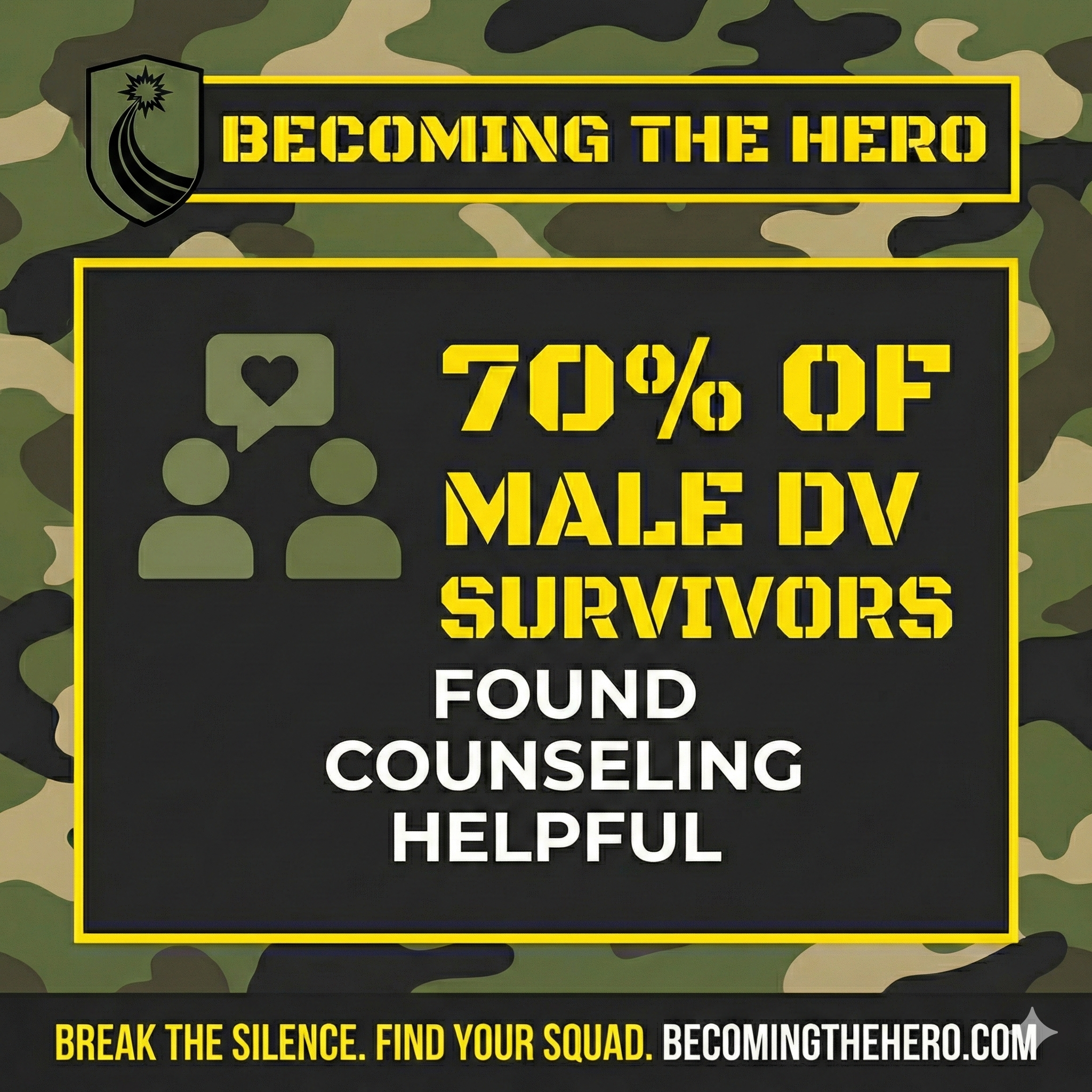
MEN TRUST COUNSELORS & THERAPISTS
The Data on Why Men Trust You
The numbers are striking — and the contrast with DV-specific services tells the whole story.
Mental health professionals:
- 66.2% of help-seeking men sought help from a mental health professional (Douglas & Hines, 2011).
- 70.6% found them “somewhat” or “very” helpful (Douglas & Hines, 2011).
- 68% reported that mental health professionals took their concerns seriously (Douglas & Hines, 2011).
DV hotlines and agencies:
- 63.9% of men who contacted a DV hotline were told “we only help women” (Douglas & Hines, 2011).
- 40.2% who contacted a DV agency were accused of being the batterer (Douglas & Hines, 2011).
- ~67% rated DV agencies and hotlines as “not at all helpful” — average rating 2.68 out of 5 (Douglas & Hines, 2011).
Law enforcement:
- ~40% of men who called police reported that police “did nothing” (Douglas & Hines, 2011).
- 25% of men who called police for help were arrested themselves (Hall, 2016).
Informal support:
- 84.9% of men turned to friends, relatives, or attorneys — the most utilized source overall (Douglas & Hines, 2011).
You are the most trusted formal system in a landscape where every other formal system fails. That comes with both an opportunity and a responsibility.
70.6% of men found mental health professionals helpful. 63.9% were told by DV hotlines: “We only help women.” You may be the only professional who believes him.
HOW MALE DV SURVIVORS PRESENT
Male survivors of intimate partner violence present differently from female survivors in ways that can lead to misdiagnosis, under-identification, or misidentification as the perpetrator if the clinician is not attuned to the differences.
He won’t call it abuse. Most men who are being abused by a female partner will not use that word — not in the first session, possibly not for months. He may describe “a difficult relationship,” “communication problems,” “her temper,” or “things getting out of hand.” He may present with anxiety, depression, anger, or somatic complaints without connecting them to the relationship. The abuse may only surface when you ask the right questions.
He’ll minimize. “It’s not that bad.” “She only hits me when she’s drunk.” “I probably provoked her.” Minimization is a universal trauma response, but it’s amplified in men by masculine socialization. He has been taught that men endure, that men don’t complain, and that admitting to being abused by a woman is emasculating. He may describe severe abuse in casual or even humorous terms. Don’t match his tone — name what you’re hearing.
He’ll present with anger, not fear. Female survivors more commonly present with fear, anxiety, and helplessness. Male survivors more commonly present with anger, frustration, and emotional flatness. This difference leads many clinicians — particularly those trained in female-centric DV frameworks — to read the anger as aggression rather than as a trauma response. Anger in a male DV survivor is often the outward expression of the same underlying helplessness, hypervigilance, and loss of control that presents as fear in female survivors.
He may present as the identified patient in couples therapy. If he arrives in couples therapy, he may be there because she framed him as the problem — “he has anger issues,” “he’s emotionally unavailable,” “he’s controlling.” In cases of coercive control, the abuser frequently uses couples therapy as an extension of the abuse: she performs as the reasonable partner in session while continuing the abuse at home. Be cautious about couples therapy in any case where one partner may be experiencing IPV. Individual assessment is essential before couples work begins.
He’ll carry guilt about reactive abuse. Many male survivors will disclose that they yelled, cursed, shoved, or otherwise reacted to sustained provocation. They will present this as evidence that they are “just as bad” or that the abuse is “mutual.” Reactive abuse — a victim’s response to prolonged provocation — is not the same as primary aggression. The guilt he carries is a clinical indicator that warrants further exploration, not confirmation that he is the perpetrator. See our Reactive Abuse page for a full explanation of this dynamic.
He may not connect his symptoms to the relationship. Men who have been in abusive relationships for years may present with insomnia, chronic pain, gastrointestinal issues, substance use, work performance problems, or social withdrawal — without identifying the relationship as the source. Screen for IPV in any male client presenting with these patterns, particularly when they co-occur.
TREATMENT OF MALE DV SURVIVORS
Screen for IPV — even when he doesn’t bring it up.
Standard screening tools for domestic violence were designed primarily for female victims. Many use language, scenarios, or framings that men do not identify with. Consider adding behaviorally specific screening questions to your intake process:
- “Has a partner ever hit, pushed, shoved, or thrown things at you?”
- “Has a partner ever threatened to take your children, call the police on you, or file false accusations?”
- “Has a partner ever controlled your access to money, transportation, or communication?”
- “Has a partner ever monitored your phone, email, or location without your consent?”
- “Has a partner ever humiliated you, called you names, or told you that you’re worthless?”
These behavioral questions bypass the identity barrier. A man who will never say “I’m being abused” may readily say “yes, she does that.”
Understand the trauma profile.
Male IPV survivors present with trauma patterns that overlap significantly with female survivors but carry distinct features:
- 57.9% of help-seeking men met the clinical cut-off for PTSD — a rate comparable to battered women in shelters (Hines & Douglas, 2011).
- Men who experienced “intimate terrorism” (coercive controlling violence) had significantly worse mental health outcomes, including PTSD and depression, compared to men who experienced situational couple violence (Hines & Douglas, 2018).
- 32.9% of male IPV victims reported PTSD symptoms in the NISVS (Leemis et al., 2022).
Trauma modalities with strong evidence bases — EMDR, CPT, PE, IFS — are appropriate for male DV survivors. Adaptation may be needed to account for the specific shame dynamics, identity disruption, and system betrayal that characterize male victimization.
Be alert to coercive control.
Physical violence is often not the primary mechanism of abuse in cases involving male victims. The most prevalent forms of abuse reported by male help-seekers include:
- Psychological and emotional abuse: 96% of help-seekers (Hines & Douglas, 2015)
- Coercive control and isolation: 93.4% (Hines & Douglas, 2015)
- Legal and administrative aggression: 91.4% — including false accusations, custody threats, and manipulation of legal systems (Hines, Douglas, & Berger, 2015)
A man may not have been punched. He may have been controlled, isolated, surveilled, financially strangled, and threatened with the loss of his children. That is abuse — and it produces trauma responses equivalent to physical violence.
Assess for reactive abuse carefully.
When a male client discloses his own aggressive behavior in the relationship, resist the impulse to classify him as a perpetrator. Instead, assess:
- Who initiates the conflict and escalation?
- Is his behavior a pattern of control or an isolated response to provocation?
- Does he feel genuine guilt and horror at his own behavior?
- Would his behavior stop entirely if the abuse stopped?
- Does she use his reactions as leverage — threatening to tell the police, the court, or others?
If the answer to those questions points to reactive abuse, your role is to validate that distinction, not reinforce the abuser’s narrative. Telling a reactive abuse victim that he is “also abusive” is clinically harmful and factually inaccurate.
Do not recommend couples therapy as the first intervention.
In cases involving coercive control, couples therapy is contraindicated. The abuser uses the therapeutic environment to gather ammunition, perform as the reasonable partner, and further gaslight the victim. If IPV is suspected or disclosed, conduct individual assessments first. Couples work — if appropriate at all — should only occur after the abusive dynamic has been addressed and safety established.
96% of male help-seekers experienced psychological abuse. 91.4% experienced legal and administrative aggression. A man doesn’t have to be punched to be a victim.
COMMON MISTAKES
What to Avoid
The following are the most common errors clinicians make when working with male DV survivors. Each one has been documented in research and reported by male help-seekers.
Assuming he’s the perpetrator. If a man discloses relationship violence and you immediately assess for perpetrator characteristics rather than victim characteristics, you are replicating the same bias that exists in the DV system, law enforcement, and the courts. Assess first. Assume nothing.
Applying the Duluth Model framework. The Duluth Model — which frames DV as a pattern of male power and control over women — is still embedded in many clinical training programs. If your conceptualization of domestic violence assumes a male aggressor and a female victim, you are not equipped to serve male survivors. Seek additional training.
Minimizing non-physical abuse. If a male client describes coercive control, financial abuse, legal aggression, or psychological manipulation and you respond with “but has she hit you?” — you are minimizing the forms of abuse that are most prevalent and most damaging for male victims. Violence is not the only form of abuse, and for many men, it isn’t the primary one.
Treating his anger as the pathology. A man who presents with anger after years of abuse is not an “angry man with relationship problems.” He is a traumatized person expressing his pain in the way his socialization permits. Treat the trauma underneath the anger, not the anger itself.
Breaking confidentiality to “protect” his partner. If a male client discloses that he has yelled at or shoved his partner in the context of reactive abuse, the clinical and ethical response is to assess the full dynamic — not to break confidentiality, refer to a batterer intervention program, or report him based on a decontextualized disclosure. Reactive abuse in the context of ongoing victimization is not equivalent to primary aggression, and treating it as such causes direct harm to the client.
HE TRUSTED YOU!
That’s not a small thing. For a man who has been told by every other system that his experience isn’t real, isn’t serious, or is his own fault — walking into a therapist’s office and saying “something is wrong” is an act of extraordinary courage.
He chose you because the data says you’re the one professional who might actually help. Don’t make him regret it.
Believe him. Assess the full picture. Treat the trauma. And understand that for this man, sitting in that chair, you may be the difference between staying trapped and starting to heal.
That’s not pressure. That’s privilege.
RESOURCES
For legislative staff and policy researchers:
- STATISTICS — comprehensive federal data with full source citations
- REFERENCES — 48+ peer-reviewed sources in APA format
- CONTACT US — to discuss policy consultation, data requests, or briefings
Key data points for quick reference:
- 52 million men have experienced IPV in their lifetime (NISVS, Leemis et al., 2022)
- 90% of male victims received no services (NCVS, Bureau of Justice Statistics, 2019–2024)
- 2 shelters for men out of ~2,000 DV agencies (Hines, Lysova, & Douglas, 2025)
- 63.9% told “we only help women” (Douglas & Hines, 2011)
- 37x more likely to be charged (Roebuck, Pathe, & Frkovic, 2020)
- Male IPV share in NCVS grew from 10.1% (2019) to 22.2% (2024)
All statistics on this page are sourced from federal government surveys or peer-reviewed, published research. Full citations are available on our References page. We encourage independent verification of every number presented here.