THE PATH TO HEALING
You survived it. Now it’s time to come back from it.
If you’re reading this page, you’ve already done something most men in your situation never do — you’ve acknowledged that what happened to you was real, and that it left a mark.
That mark doesn’t have to be permanent.
The abuse changed you. It rewired how you think about trust, conflict, safety, and yourself. It left you hypervigilant, exhausted, numb, angry, or all of the above. You may have trouble sleeping. You may flinch at sounds that remind you of her. You may not recognize the person you’ve become.
None of that means you’re broken. It means you’re injured — and injuries heal. But they heal faster and more completely with the right help.
This page is about finding that help: what to look for, what to expect, and why the one system that consistently works for men is the one most men are afraid to try.
WHY THERAPY WORKS FOR MEN
The research on this point is remarkably clear — and remarkably encouraging.
In the most comprehensive study of male DV help-seeking, mental health professionals were the most effective formal resource men accessed:
- 66.2% of help-seeking men sought help from a mental health professional — making it one of the most utilized formal resources (Douglas & Hines, 2011).
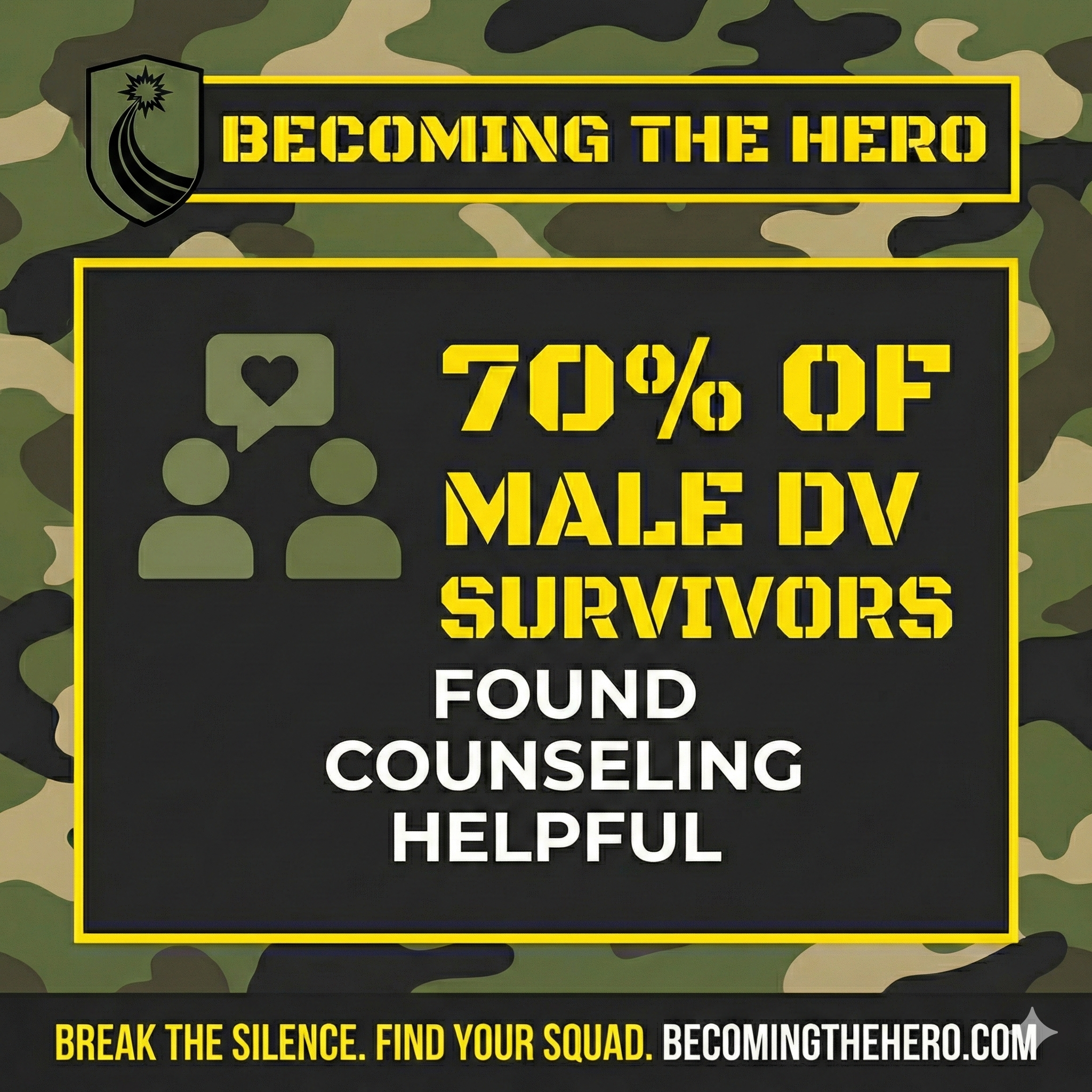
- 70.6% found them “somewhat” or “very” helpful (Douglas & Hines, 2011).
- 68% reported that mental health professionals took their concerns seriously (Douglas & Hines, 2011).
Compare that to the DV system:
- Only 33% of men rated DV agencies as helpful.
- 63.9% who called a DV hotline were told “we only help women.”
- 40.2% who contacted a DV agency were accused of being the batterer.
70.6% of men found therapists helpful. DV agencies scored 33%. Therapy isn’t the backup plan. For men, it is the plan.
FINDING THE RIGHT THERAPIST
Not every therapist is the right fit — and for male DV survivors, the wrong therapist can do real harm. Here’s what to look for.
What to look for:
Experience with trauma. Look for therapists who specialize in trauma, PTSD, or complex trauma. The abuse you experienced creates neurological and psychological patterns that general talk therapy alone may not address. Modalities that have strong evidence for trauma recovery include:
- EMDR (Eye Movement Desensitization and Reprocessing) — effective for processing traumatic memories
- CPT (Cognitive Processing Therapy) — helps restructure distorted beliefs created by trauma
- PE (Prolonged Exposure) — helps reduce avoidance patterns linked to PTSD
- IFS (Internal Family Systems) — useful for addressing the fragmented sense of self that prolonged abuse creates
Experience with domestic violence. A therapist who understands DV dynamics — coercive control, reactive abuse, trauma bonding, gaslighting — will be far more effective than one who treats your experience as a “bad relationship.” Ask directly: “Do you have experience working with domestic violence survivors?”
Experience with men. This matters more than it might seem. Male survivors present differently from female survivors — more anger, more minimization, more shame about asking for help. A therapist who understands masculine socialization and the specific barriers men face in DV contexts will be better equipped to meet you where you are.
No Duluth Model bias. Some therapists — particularly those trained through the DV system — may default to the Duluth Model framework, which assumes domestic violence is a pattern of male power and control. If your therapist suggests you may be the abuser, minimizes your experience, or seems skeptical of female-perpetrated violence, find a different therapist. You deserve someone who believes you.
Where to search:
- Psychology Today’s therapist directory (psychologytoday.com) — filter by specialty (trauma, PTSD, domestic violence, men’s issues), insurance, and location
- Your insurance provider’s directory — call the number on your insurance card and ask for therapists specializing in trauma or DV
- Your employer’s EAP (Employee Assistance Program) — most EAPs offer 3–8 free sessions, and the referral is confidential from your employer
- SAMHSA’s helpline (1-800-662-4357) — free referrals to local treatment facilities and mental health services
- Open Path Collective (openpathcollective.org) — affordable therapy for people without insurance or with high deductibles, sessions between $30–$80
- BetterHelp or Talkspace — online therapy platforms that offer flexibility if in-person isn’t safe or accessible. Not ideal for deep trauma work, but a good starting point.
What to ask in a first session:
- “Do you have experience working with domestic violence survivors?”
- “Do you have experience working with male clients in abusive relationships?”
- “What therapeutic modalities do you use for trauma?”
- “How do you approach situations where the client was abused by a female partner?”
If the answers feel wrong — if you sense skepticism, discomfort, or a default assumption that you must be the aggressor — trust your instinct and try someone else. The right therapist is out there.
WHAT TO EXPECT FROM THERAPY
If you’ve never been to therapy — or if your only experience was unhelpful — here’s what to expect.
The first sessions are assessment.
Your therapist will want to understand your history, your current situation, and what you want to work on. You don’t have to tell everything right away. A good therapist will let you set the pace. You’re in control of what you share and when.
It gets harder before it gets easier.
Therapy works by bringing things to the surface that you’ve been suppressing — sometimes for years. That process can feel destabilizing. You may feel worse in the first few weeks as you start confronting what happened. This is normal. It doesn’t mean therapy isn’t working. It means it is.
You’ll learn what happened to you has a name.
Many men in abusive relationships have never had their experience validated by a professional. Hearing a therapist say “what you went through was abuse” — and mean it — can be one of the most powerful moments in recovery. You may also learn clinical terms for what you experienced: coercive control, trauma bonding, reactive abuse, complex PTSD. These aren’t labels to trap you. They’re language to free you.
It takes time.
Therapy is not a quick fix. Depending on the severity and duration of the abuse, meaningful recovery can take months or longer. But it compounds — each session builds on the last. The man who walks into session twenty is not the same man who walked into session one.
You can stop or switch at any time.
If a therapist isn’t the right fit, you’re not stuck. Try another one. The therapeutic relationship matters as much as the modality. You deserve someone who gets it.
IMPACTS OF DOMESTIC VIOLENCE
What You May Be Dealing With
Abuse leaves specific, documented patterns. Recognizing them is part of healing.
PTSD and Complex PTSD. 57.9% of help-seeking male DV survivors met the clinical cut-off for PTSD (Hines & Douglas, 2011) — a rate comparable to battered women in shelters. Symptoms include flashbacks, nightmares, hypervigilance, emotional numbness, and avoidance of anything that reminds you of the abuse. Complex PTSD, which results from prolonged and repeated trauma, can also include difficulties with emotional regulation, a persistent negative self-image, and problems in relationships.
Trauma bonding. You may still have feelings for your abuser. You may miss her. You may remember the good times and question whether the bad times were really that bad. This is trauma bonding — a neurological attachment pattern created by intermittent reinforcement (cycles of abuse and affection). It is not love. It is a survival adaptation. A therapist can help you distinguish between the two.
Shame and self-blame. You may believe it was your fault. You may believe you should have been stronger, should have left sooner, should have handled it differently. These beliefs were planted by your abuser and reinforced by a culture that tells men they can’t be victims. They are not true. Therapy helps you dismantle them.
Anger. Men who have been abused often carry enormous anger — at her, at the system, at themselves. That anger is valid. But unprocessed, it can damage your other relationships, your parenting, your work, and your health. Therapy gives it somewhere to go.
Difficulty trusting. After years of manipulation, deception, and betrayal, trusting anyone feels dangerous. You may push people away, test relationships, or assume everyone has an agenda. This is a protective response that made sense in the context of abuse. In the context of recovery, it becomes a barrier. A therapist can help you learn to trust again — slowly, safely, at your own pace.
Identity loss. Prolonged abuse erodes your sense of who you are. You may have lost hobbies, friendships, ambitions, and confidence. You may not recognize yourself. Recovery is not just about processing the trauma — it’s about rediscovering the man underneath it.
57.9% of help-seeking male DV survivors met the clinical cut-off for PTSD — a rate comparable to battered women in shelters. You’re not overreacting. What happened to you was real.
OVERCOMING BARRIERS
Barriers — and How to Get Past Them
You already know you should probably talk to someone. Here’s what’s stopping you — and why it shouldn’t.
“I can’t afford it.” Many therapists offer sliding scale fees. EAPs through your employer offer free sessions. Open Path Collective offers sessions for $30–$80. Community mental health centers offer low-cost or free services. Medicaid covers therapy in every state. The cost barrier is real — but it’s often lower than you think.
“I don’t have time.” Telehealth has made therapy more accessible than ever. Many therapists offer evening and weekend sessions. A weekly 50-minute session is less time than you spend managing the fallout of untreated trauma. You have time. You just haven’t made it a priority yet — and that’s okay. Start when you’re ready.
“It’s not that bad.” 57.9% of help-seeking men met the clinical threshold for PTSD. If that number applied to any other injury — a broken bone, a concussion, a heart condition — you wouldn’t hesitate to see a doctor. Your psychological injuries are just as real and just as deserving of treatment.
“Men don’t go to therapy.” 66.2% of help-seeking male DV survivors did. And 70.6% of them found it helpful. The stigma is outdated. The men who go to therapy aren’t weak — they’re the ones who decided to stop carrying it alone.
“She’ll find out.” Use your EAP — it’s confidential from your employer and your spouse. Pay with cash or a separate account. Schedule sessions during work hours or say you’re going to the gym. Use telehealth from your car, your office, or a private space. If she’s monitoring your phone, use the digital safety steps from our Immediate Safety page.
“What if the therapist doesn’t believe me?” Some won’t. Find another one. Use the questions above in your first session to screen for bias. A therapist who doesn’t believe men can be abused is not a therapist you want. The right one is out there — and when you find them, it will change your life.
RESOURCES
Find a therapist:
- Psychology Today directory: psychologytoday.com/us/therapists
- SAMHSA helpline: 1-800-662-4357
- Your employer’s EAP (call HR or your benefits line)
Crisis support:
- National Domestic Violence Hotline: 1-800-799-7233 (call) or text START to 88788
- Crisis Text Line: Text HOME to 741741
- 988 Suicide and Crisis Lifeline: Call or text 988
- If in immediate danger, call 911
On this site:
- IS IT ABUSE?— if you’re still assessing what’s happening
- PLAN A SAFE EXIT — the full guide to building your exit plan
- THE HERO’S JOURNEY — you’re not a victim. You’re a hero.
YOU DESERVE TO HEAL
You didn’t deserve what happened to you. You don’t deserve to keep carrying it. And you don’t have to.
The man you were before the abuse is still in there. The man you’re becoming — the one who’s reading this, searching for answers, deciding to fight for himself — that man is already on his way back.
Therapy isn’t admitting defeat. It’s the next step on the hero’s journey.
Take it.
All statistics on this page are sourced from federal government surveys or peer-reviewed, published research. Full citations are available on our References page. We encourage independent verification of every number presented here.