FRIENDS & FAMILY
You see something wrong. You don’t know what to say.
This page will help you understand what’s happening — and what he needs from you.
You might not be sure. Maybe he’s more withdrawn than usual. Maybe he makes excuses for her behavior — or for the bruises. Maybe his kids seem anxious, or he’s lost weight, or he flinches when his phone rings. Maybe he made a joke about it once and you didn’t know if he was serious.
He probably was.
Men in abusive relationships rarely ask for help directly. They’ve been told — by society, by the system, and often by their abuser — that what’s happening to them isn’t real, isn’t serious, or is their own fault. Most will never use the word “abuse” to describe their experience, even when it’s severe.
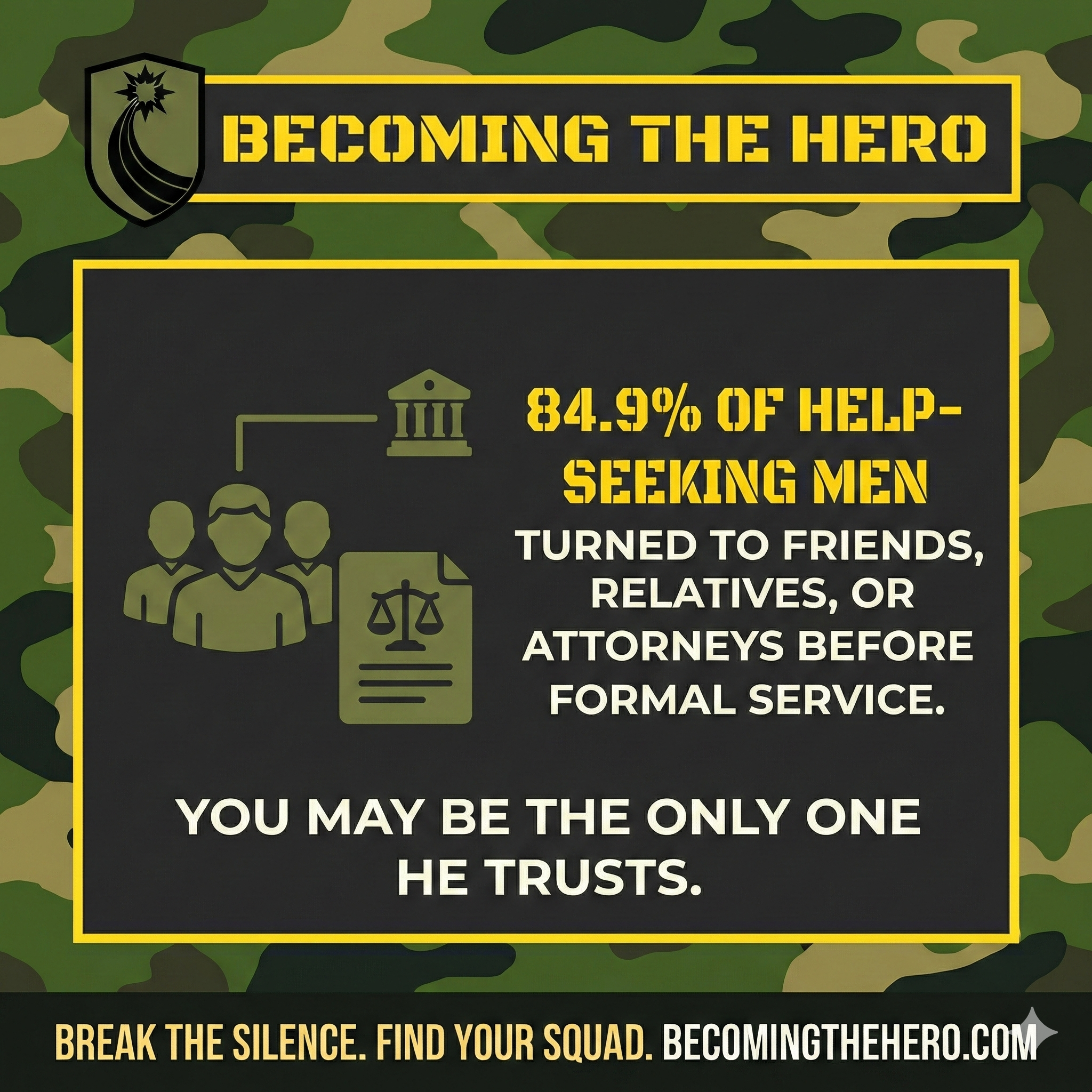
That’s where you come in. Friends and family are the most utilized source of support for male victims of intimate partner violence. In one study, 84.9% of help-seeking men turned to friends, relatives, or attorneys before any formal service (Douglas & Hines, 2011).
You may be the only person he trusts enough to tell. This page will help you be ready.
WHAT YOU MIGHT BE SEEING
Abuse doesn’t always look the way you expect. For men, the signs are often subtle, indirect, or easy to explain away. Here’s what to watch for:
Changes in behavior or personality: He’s become quieter, more anxious, or seems to be walking on eggshells. He checks his phone constantly or panics when he misses a call from her. He’s stopped doing things he used to enjoy. He seems exhausted, defeated, or emotionally flat.
Isolation: He’s pulled away from friends and family. He cancels plans at the last minute or always has an excuse. He never comes to anything alone — she’s always there. Or the opposite: she’s made it clear his friends and family aren’t welcome.
Excuses and minimization: He explains away injuries, mood changes, or her behavior. “She just has a temper.” “It’s not that bad.” “I probably deserved it.” “She’s going through a hard time.” He may laugh it off or downplay what’s happening — because admitting it would mean admitting he’s being abused, and he’s not ready for that.
Financial changes: He seems to have less money than he should. He can’t make decisions about purchases. He asks to borrow money for things he should be able to afford. She controls the accounts, the credit cards, or his access to cash.
Her behavior in front of you: She belittles him, corrects him, or speaks for him. She monitors his conversations. She makes “jokes” about his inadequacy — as a man, a father, or a partner — and watches to see if he reacts. She flips between charm and cruelty depending on the audience.
His relationship with his children: He seems afraid of losing access to his kids. He stays “for the children.” He’s mentioned custody threats or her using the kids against him. The children seem anxious, or they side with the mother in ways that feel coached.
WHAT HE’S UP AGAINST
If you’re wondering why he hasn’t told you, understand what telling you would require:
Admitting he’s a “victim.” Men are socialized to be strong, to protect, to endure. Admitting to being abused by a female partner contradicts everything he’s been taught about what it means to be a man. The shame is paralyzing (Taylor et al., 2021).
Risking disbelief. 49% of male victims cite fear of not being taken seriously as a primary reason for not reporting (Drijber et al., 2013). He’s already calculated whether you’ll believe him — and he’s not sure you will.
Risking her retaliation. If she finds out he told someone, the abuse often escalates. 56% of men in one study reported their partners made false accusations against them (George Mason University, 2022). Telling you could trigger a custody battle, a restraining order, or a call to the police — against him.
Knowing the system won’t help. 63.9% of men who called DV hotlines were told “we only help women” (Douglas & Hines, 2011). 25% of men who called police for help were arrested themselves (Hall, 2016). He may have already tried to get help and been turned away — or worse, punished for asking.
Protecting the family. Many men stay because they believe leaving will mean losing their children. They act as a “buffer” between the abuser and the kids, absorbing the abuse to shield them (Hines & Douglas, 2010; Commissioner for Victims of Crime Northern Ireland, 2024).
He’s not staying because he’s weak. He’s staying because every option he can see is worse than the one he’s in.
HE NEEDS YOU!
84.9% of help-seeking men turned to friends, relatives, or attorneys first. You may be his only lifeline.
HOW TO HELP
You don’t need to be a therapist. You don’t need to fix it. You need to be the person who doesn’t look away.
1. Believe him.
This is the most important thing you can do. Don’t question whether it’s “really” abuse. Don’t ask what he did to provoke it. Don’t say “but she seems so nice.” If he’s telling you — or even hinting — take it seriously. He has already spent months or years questioning himself. He doesn’t need you to do it too.
2. Name it without forcing it.
You can say what you see without demanding he label it. Try:
- “I’ve noticed she talks to you in a way that doesn’t seem right.”
- “The way she treats you concerns me.”
- “You don’t seem like yourself lately, and I want you to know I’m paying attention.”
- “If something’s going on at home, I’m here. No judgment.”
Don’t say: “You’re being abused.” He’s not ready to hear that — and pushing the label too early can make him shut down. Let him arrive at it on his own timeline.
3. Don’t give ultimatums.
“Just leave her” is not helpful. Leaving an abusive relationship is the most dangerous time for any victim — and for a man, leaving often means losing his children, his home, and his financial stability with no shelter to go to. There are two DV shelters for men in the entire United States (Hines, Lysova, & Douglas, 2025).
Instead of “just leave,” try: “When you’re ready, I’ll help you figure it out.”
4. Offer practical support.
What he needs most is someone who will show up, not just say the right things. Depending on where he is in the process, that might look like:
- A safe place to talk — somewhere she can’t overhear or monitor.
- A place to stay — if he leaves, even temporarily, he may need a couch, a spare room, or a quiet place to think.
- Help with documentation — encourage him to keep a private record of incidents (dates, times, what happened, photos of injuries). This matters enormously if custody becomes an issue.
- Financial support — even small amounts can help a man who has no access to his own money.
- Childcare backup — if he’s the primary caregiver and needs to see a lawyer, a counselor, or just take a breath.
- Research — look up therapists, legal aid, and male-friendly DV resources in your area so he doesn’t have to do it while living under her surveillance.
5. Don’t go around him.
Don’t confront her. Don’t call the police on his behalf without his knowledge. Don’t tell other family members without his permission. Any of these can escalate the situation and put him — and possibly his children — in greater danger. Let him lead. Your job is to support, not to rescue.
6. Be patient.
The average victim of domestic violence attempts to leave seven times before leaving for good. He may go back. He may minimize it again. He may shut you out for a while. That doesn’t mean your support didn’t matter. It means the process is longer than you want it to be. Stay consistent. Stay available. Don’t give up on him.
WHAT NOT TO SAY
These responses are well-intentioned. They are also the fastest way to make a male victim shut down and never bring it up again.
“Why don’t you just leave?” Because he’ll lose his kids. Because there’s nowhere to go. Because she’ll call the police and he’ll be the one in handcuffs. Because leaving is not simple — it’s a calculated risk with consequences he’s already mapped out.
“But you’re bigger than her.” Size doesn’t determine who’s the abuser. Abuse is about control, not physical strength. And many men who are hit, slapped, or attacked with objects never fight back — because they know that if they do, they become the aggressor in the eyes of the law.
“She seems so nice.” Abusers are often charming in public. That’s part of the control. The contrast between her public persona and her private behavior is what makes him feel crazy — and what makes him sure no one will believe him.
“Man up.” This is the phrase that keeps men trapped. It tells him that his pain isn’t valid, that he should be able to handle it, and that asking for help is weakness. It is the exact message his abuser is already giving him.
“Are you sure it’s that bad?” Yes. He’s sure. He’s been minimizing it for years — he doesn’t need you to help him do it. If he’s brought it up at all, it’s worse than what he’s telling you.
DON’T TRY TO FIX IT!
You don’t need to fix it. You need to be the person who doesn’t look away.
RESOURCES
For him:
- National Domestic Violence Hotline: 1-800-799-7233 (call) or text START to 88788
- Crisis Text Line: Text HOME to 741741
- IS IT ABUSE? — our screening tool for men
- RESOURCES FOR MEN — safety planning, legal info, path to healing
For you:
- THE STATISTICS — the data behind everything on this page
- CONTACT US — if you need guidance on how to support someone specific
If you’re worried about his immediate safety or the safety of his children, encourage him to call the hotline or reach out to a local mental health professional. Unlike DV agencies, 70.6% of men found mental health professionals helpful and willing to take their concerns seriously (Douglas & Hines, 2011).
HE NEEDS YOU
He Needs Someone Who Sees It
Most men in abusive relationships have convinced themselves that no one notices, no one cares, and no one would believe them if they told the truth.
You’re reading this page because you noticed. That already makes you different.
Now don’t look away.
All statistics on this page are sourced from federal government surveys or peer-reviewed, published research. Full citations are available on our References page. We encourage independent verification of every number presented here.