CLERGY & FAITH LEADERS
He Trusts God & He Trusts You
He came to you because he trusts God. Make sure the advice you give him doesn’t keep him trapped.
If you are a pastor, priest, deacon, minister, rabbi, imam, or any faith leader in a position of pastoral care, there is a reasonable chance that a man in your congregation is being abused by his wife — and that he has come to you, or will come to you, looking for guidance.
What you say next matters more than you know.
Men in abusive relationships frequently turn to faith communities before they turn to any formal service. They trust you. They believe you will understand. And in many cases, the advice they receive — rooted in sincerely held theological convictions about marriage, headship, forgiveness, and sacrifice — sends them back into danger.
This page is not a critique of your theology. It is a request that your pastoral counsel account for the reality of domestic abuse — including the reality that men can be victims and women can be perpetrators.
Full citations are available on our References page.
HOW MEN DISCLOSE TO CLERGY
What He’s Telling You (and What He’s Not)
A man who comes to you about his marriage is almost certainly not going to say “my wife is abusing me.” He will say something like:
- “We’re going through a rough patch.”
- “She has a temper, but I know she’s dealing with a lot.”
- “I don’t know how to lead my family anymore.”
- “I think I’m failing as a husband.”
- “I need to be more patient. I just don’t know how.”
- “She says I’m the problem, and maybe she’s right.”
Listen carefully to what’s underneath those statements. A man who describes himself as “failing” in a marriage where his wife controls the finances, monitors his phone, threatens to take the children, belittles him in front of others, and occasionally hits him is not failing. He is being abused.
He may also disclose that he has reacted — yelled, cursed, shoved, or lost his temper. He will present this as evidence that he is equally at fault or that the problem is mutual. It usually isn’t. Reactive abuse — a victim’s response to sustained provocation — is not the same as being an abuser. The guilt he carries is a sign that he’s a good man in a terrible situation, not that he’s the source of the problem.
HARMFUL PASTORAL RESPONSES
The following are common pastoral responses to men disclosing marital distress in the context of abuse. Each one, however well-intentioned, can reinforce the abuse dynamic and endanger the man and his children.
“You need to love her like Christ loved the Church.” This is theologically sound in a healthy marriage. In an abusive marriage, it becomes a mandate to absorb unlimited harm. Christ’s sacrificial love was not directed at someone who was systematically destroying Him — it was offered freely in a context of divine purpose. Telling an abused man to “love harder” tells him that his suffering is his calling and that setting a boundary is a spiritual failure. It isn’t.
“Marriage is a covenant. You need to fight for it.” A covenant requires two willing participants acting in good faith. When one partner is using violence, control, and manipulation to dominate the other, the covenant has already been broken — and it was not broken by the victim. Encouraging a man to “fight for his marriage” when his wife is abusing him tells him to fight for the structure that is destroying him.
“Have you tried praying about it?” He has. For years. Prayer is not a substitute for safety planning. A man who has been abused deserves both spiritual support and practical intervention. If your only response to his disclosure is to pray with him and send him home, you are sending him back to the abuse with nothing but hope — and hope without action is not a plan.
“What role are you playing in this?” In a healthy marriage struggling with communication, this question is appropriate. In an abusive marriage, it is victim-blaming. It tells him that the abuse is at least partially his fault and that if he could just be a better husband, she would stop hurting him. Abuse is a choice made by the abuser. The victim’s behavior does not cause it and cannot cure it.
“Divorce is not an option.” For many faith traditions, this is a deeply held conviction. But even traditions with the strictest positions on divorce — including Catholicism — recognize that physical separation for safety is not only permissible but sometimes necessary. No legitimate theology requires a person to remain in a home where they are being physically or psychologically destroyed. If your theological framework leads you to counsel a man to stay in a home where he is being abused, the framework is being misapplied — not followed.
“She’s your wife. She wouldn’t do that.” Yes, she would. And she is. Disbelief is the single most common response men receive from every system they approach — hotlines, agencies, police, courts, and clergy. If he has come to you with this, he has already spent months or years questioning whether anyone will believe him. Don’t be another person who confirms his fear.
No legitimate theology requires a person to remain in a home where they are being destroyed. Safety is not a sin. Setting a boundary is not a betrayal of your vows.
HELPFUL PASTORAL RESPONSES
What you can do instead…
1. Believe him.
Start here. If a man in your congregation has come to you with even a hint that his wife is abusing him, take it seriously. He has already overcome enormous shame to tell you. He has calculated whether you’ll believe him. Prove that he was right to trust you.
2. Name what you’re hearing.
You don’t have to be a counselor to reflect back what he’s describing. “What you’re telling me sounds like abuse.” “That’s not a rough patch — that’s someone controlling you.” “You’re not failing as a husband. You’re being hurt by your wife.” He may have never heard anyone say those words to him. It may be the first time he’s heard his experience validated by someone he respects.
3. Separate the marriage from the abuse.
You can honor the sacredness of marriage while acknowledging that this particular marriage is dangerous. Separation for safety is not the same as abandonment. It is not the same as divorce. It is a man protecting himself and his children from ongoing harm. Frame it that way — because he needs theological permission to save himself, and you may be the only person who can give it to him.
4. Don’t counsel couples together.
If abuse is present, couples counseling — including pastoral marriage counseling — is contraindicated. The abuser uses the counseling environment to perform as the reasonable partner, gather ammunition, and continue the manipulation. If he comes to you with his wife, find a way to speak with him alone. His safety depends on it.
5. Refer to professional help.
You are a spiritual leader, not a clinician. Domestic violence involves legal, psychological, and safety dimensions that pastoral care alone cannot address. The most helpful thing you can do — after believing him — is connect him with:
- A mental health professional experienced with trauma and DV (70.6% of men found them helpful)
- A family law attorney who can advise on custody and protection
- The National DV Hotline: 1-800-799-7233
- The resources on this site, including our Safety Planning page
Referring him to a professional is not passing the buck. It’s making sure he gets the level of support the situation demands.
6. Offer sanctuary.
Not metaphorically — literally. If he needs a place to go, a safe room to make a phone call, a trusted witness, or someone to hold his documentation, offer that. Faith communities have resources that formal systems don’t: a network of people who care, a physical space, and a tradition of sheltering people in need. Use it.
7. Preach about it.
Not about him specifically — but about the reality that domestic abuse happens to men. A single sermon, a mention in a men’s group, a line in a prayer: “We pray for all who are in abusive homes — including the men who suffer in silence.” That sentence, spoken from the pulpit, may be the first time a man in your congregation realizes that someone sees him.
THEOLOGY & ABUSE
A Brief Theological Framework
Every major faith tradition affirms the dignity of the human person. Every major tradition recognizes that suffering inflicted by one person on another — deliberately, repeatedly, and with the intent to control — is a moral wrong. Domestic violence is not a “marriage problem.” It is a violation of the dignity that every faith teaches is inherent in every human being.
A man who is being abused is not being called to suffer. He is being harmed. There is a theological difference between sacrificial love offered freely and abuse endured under coercion. The first is a gift. The second is a wound.
A man who sets a boundary is not abandoning his vows. He is honoring the version of himself — and his family — that the vows were meant to protect. No vow requires self-destruction.
A man who leaves an abusive home is not breaking his family. The abuser broke it. He is saving what’s left.
If your theology leads you to tell a man to stay in a home where he is being abused, the problem is not with the man. The problem is with how the theology is being applied.
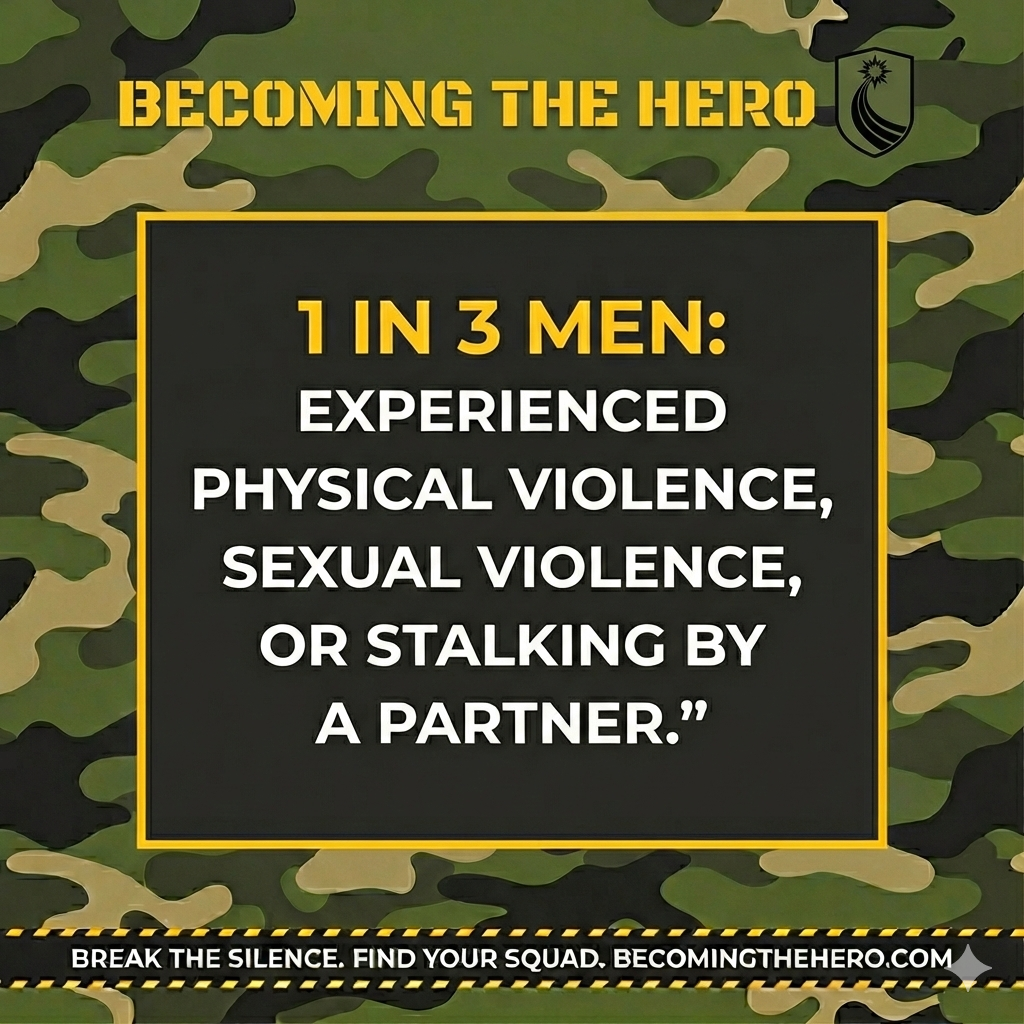
84.9% of help-seeking men turned to informal support — friends, family, and faith leaders — before any formal system. You may be the first person he’s ever told.
SHEPHERD ALL OF THEM
He came to you because he believes God cares about what’s happening to him. He came to you because he trusts that the Church — the temple, the mosque, the synagogue — is a place where suffering is seen and not dismissed.
He’s sitting in your office, or standing in the hallway after service, or sending you a text at midnight — trying to find the words for something he’s never told anyone.
Don’t send him home with a prayer and a platitude. Send him home with a plan, a referral, and the knowledge that his faith leader sees what’s happening and will not look away.
That’s shepherding. All of them.
RESOURCES
For your staff & leaders:
- STATISTICS — the data on male victimization, help-seeking, and system failure
- REACTIVE ABUSE — understanding why his reaction doesn’t make him the abuser
- REFERENCES — 48+ peer-reviewed sources in APA format
- CONTACT US — to discuss training or consultation for your faith community
For the men in your congregation:
- National Domestic Violence Hotline: 1-800-799-7233 (call) or text START to 88788
- Crisis Text Line: Text HOME to 741741
- 988 Suicide and Crisis Lifeline: Call or text 988
- IS IT ABUSE — a screening tool designed for men
- SAFETY PLANNING — how to build a safe exit plan
- THE HERO’S JOURNEY — he’s not a victim. He’s a hero.
All statistics on this page are sourced from federal government surveys or peer-reviewed, published research. Full citations are available on our References page. We encourage independent verification of every number presented here.