LAWMAKERS & DV
The data exists. The policy doesn’t. This page is about closing that gap.
If you write, sponsor, vote on, or advise on domestic violence legislation, this page was built for you.
The federal government’s own data documents that men experience intimate partner violence at rates that — depending on the survey and the measure — range from roughly equal to women to approximately half the rate of women. By any measure, we are talking about tens of millions of American men.
The policy response to that data has been, effectively, nothing.
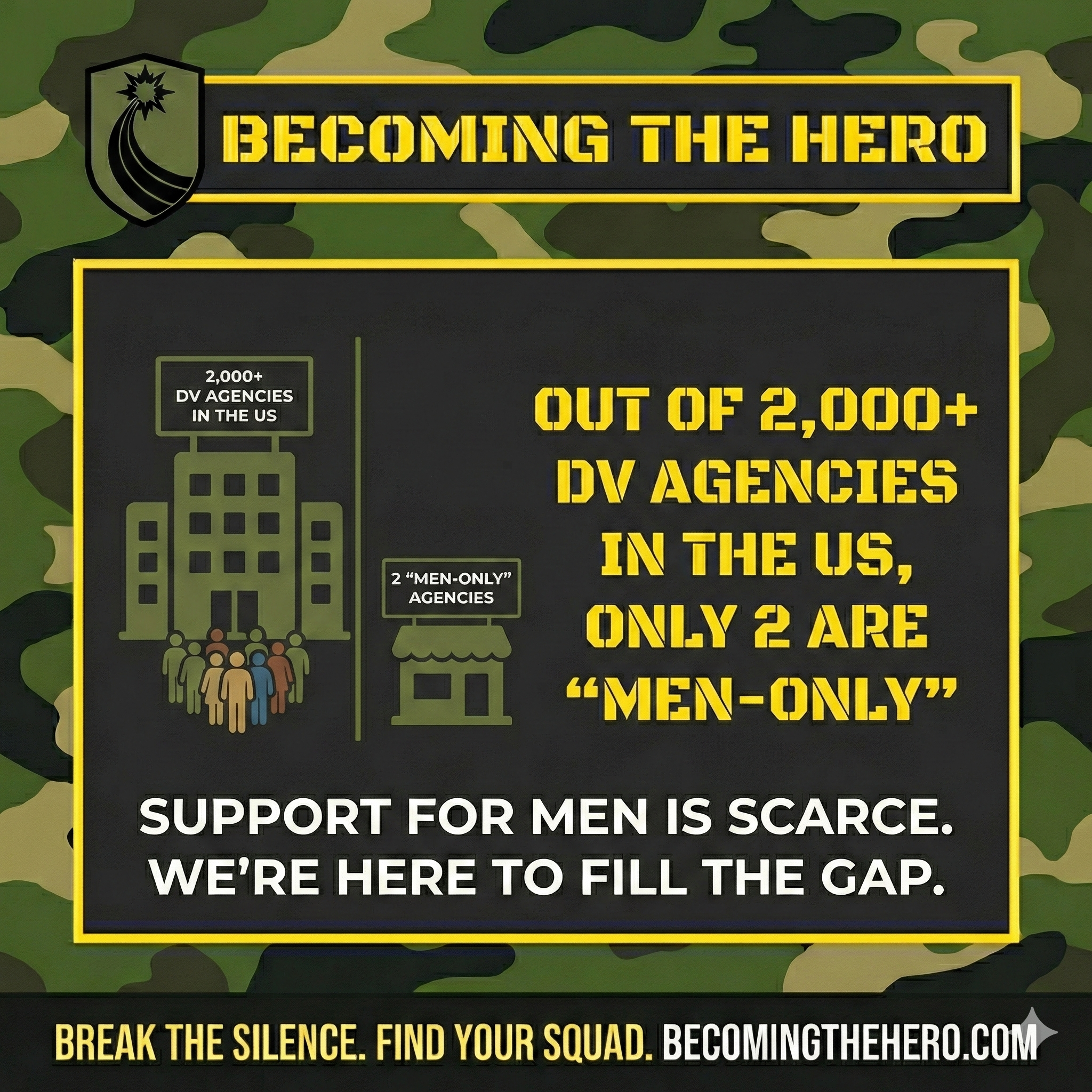
There are approximately 2,000 DV agencies in the United States. Two of them serve men. Federal funding overwhelmingly flows to services that exclude male victims — not by statute, but by practice and culture. State laws designed to protect DV victims often produce the opposite outcome for men, criminalizing them for seeking help.
This page presents the data, identifies the policy gaps, and offers a framework for gender-inclusive DV legislation that protects all victims without reducing services to women.
Every number on this page is sourced from federal surveys or peer-reviewed research. We encourage your staff to verify every claim independently.
Full citations are available on our References page.
THE FEDERAL DATA
Two federal surveys measure intimate partner violence. They produce different numbers because they ask different questions — but both document significant male victimization.
National Crime Victimization Survey (NCVS)
Bureau of Justice Statistics, Department of Justice
The NCVS asks respondents whether they were a victim of a crime. Because men are socialized not to identify their experiences as criminal victimization, this survey produces the lowest estimates of male IPV.
- Men accounted for 15% of IPV victimizations from 2019–2024.
- In 2024 alone, that share rose to 22.2% — representing 173,548 male victims in a single year.
- From 2019–2024, the NCVS documented 603,949 male IPV victimizations total.
National Intimate Partner and Sexual Violence Survey (NISVS)
Centers for Disease Control and Prevention
The NISVS asks about specific behaviors — hitting, pushing, shoving, controlling — regardless of whether the respondent labels the experience a crime. This survey consistently finds near-parity between male and female victimization.
- 42.3% of men (49.9 million) experienced physical violence by a partner in their lifetime, compared to 42.0% of women (52 million) (Leemis et al., 2022).
- 44.2% of men (52.1 million) experienced contact sexual violence, physical violence, and/or stalking by a partner in their lifetime (Leemis et al., 2022).
- 45.1% of men (53.3 million) experienced psychological aggression by a partner in their lifetime (Leemis et al., 2022).
What the gap means
When the NCVS asks men “were you a victim of a crime?”, most say no — even when they’ve been hit, controlled, or sexually coerced. When the NISVS asks “did a partner ever hit, push, shove, or slam you?”, men report at rates virtually identical to women.
The gap is not in the violence. It’s in whether the victim labels it a crime. Policy should be informed by what’s happening, not by whether the victim has the language to call it what it is.
52 million men have experienced intimate partner violence in their lifetime. There are 2 shelters in the United States dedicated to serving them.
THE SERVICE GAP
The disparity between male victimization rates and male service access is the central policy failure.
Shelter access:
- There are approximately 2,000 DV agencies and hotlines in the United States. Only two are dedicated to male victims (Hines, Lysova, & Douglas, 2025).
- 5% of male survivors accessed DV shelters, compared to 26% of female survivors (Roebuck, Pathe, & Frkovic, 2020).
Victim services:
- Only 9.8% of male IPV victims received any form of victim services, compared to 25.9% of female victims — a 2.6x gap (Bureau of Justice Statistics, 2019–2024).
- 90% of male victims received no services at all.
Victim advocates:
- 0.6% of male victims (701,000 men) needed victim advocate services, compared to 6.0% of female victims (7.5 million women) — a 10x gap in access (Leemis et al., 2022).
Crisis services:
- 1.5% of male victims contacted a crisis hotline, compared to 6.1% of female victims — a 4.1x gap (Leemis et al., 2022).
Housing services:
- 1.4% of male victims needed housing services, compared to 5.5% of female victims — a 3.9x gap (Leemis et al., 2022).
Agency outcomes when men do seek help:
Over 25% were referred to a batterer’s intervention program when they were the victim (Douglas & Hines, 2011).
63.9% of men who contacted a DV hotline were told “we only help women” (Douglas & Hines, 2011).
40.2% who contacted a DV agency were accused of being the batterer (Douglas & Hines, 2011).
Over 25% were referred to a batterer’s intervention program when they were the victim (Douglas & Hines, 2011).
THE FUNDING PROBLEM
Federal DV funding flows primarily through the Violence Against Women Act (VAWA), first enacted in 1994 and reauthorized multiple times since.
VAWA is technically gender-neutral in its victim service provisions. Any victim of DV, regardless of gender, is eligible for services funded under the Act. But the name, the legislative history, the implementation guidance, and the culture that has developed around VAWA have created a funding ecosystem that overwhelmingly serves women — not because the law requires it, but because the system was built that way.
The Structural Problem:
- VAWA funding flows to state coalitions, which distribute it to local DV agencies. The vast majority of these agencies were founded to serve women and have no infrastructure, training, or mandate to serve men.
- Grant applications, reporting requirements, and performance metrics are often structured around female victimization. An agency that wants to expand services to men may find that doing so creates reporting complications or jeopardizes its alignment with funder expectations.
- There is no dedicated federal funding stream for male DV victims. No set-aside. No targeted grant program. No mandate to include men in service delivery.
The Result:
Billions of federal dollars have flowed into domestic violence services over three decades. The number of shelters dedicated to male victims in the United States remains two.
This is not a funding problem. It is a policy design problem. And it can be fixed without reducing a single dollar of funding for women’s services.
VAWA is technically gender-neutral. The implementation is not. Billions of dollars over three decades. Two shelters for men.
THE CRIMINAL JUSTICE PROBLEM
Why This Matters to Men
State-level DV laws — particularly primary aggressor statutes and mandatory arrest policies — were designed to protect victims from being re-victimized by the justice system. For female victims, they have largely succeeded. For male victims, they have produced the opposite effect.
Arrest disparities:
- 25% of men who called police for help were arrested themselves (Hall, 2016).
- Male victims are 37 times more likely to be charged than female victims when no injuries are present (Millar & Brown, 2010 cited in Roebuck, Pathe, & Frkovic, 2020).
- Injured male victims are charged 16% of the time, compared to only 1% of injured female victims (Roebuck, Pathe, & Frkovic, 2020).
Primary aggressor laws:
- Dual arrests were 56% less likely when the offender was male — indicating police default to treating the man as the sole aggressor (Hirschel & Deveau, 2016).
- In states with primary aggressor statutes, the overall likelihood of any arrest decreased by nearly a third — suggesting officers choose to arrest no one rather than identify a female primary aggressor (Hirschel & Deveau, 2016).
Protection orders:
- Judges were almost 13 times more likely to grant a restraining order when requested by a female plaintiff against a male partner than by a male plaintiff against a female partner (Muller et al., 2009 cited in Hobbs, 2023).
False accusations as a weapon:
- 56% of men experiencing female-perpetrated violence reported their partners made false accusations of physical or sexual abuse (George Mason University, 2022).
- 91.4% of help-seeking men reported experiencing “legal and administrative aggression” — false reports, false accusations of child abuse, and manipulation of protection order processes (Hines, Douglas, & Berger, 2015).
The laws are not flawed. The implementation is. When police training, judicial practice, and prosecutor discretion all default to “male = aggressor,” gender-neutral laws produce gendered outcomes.
POLICY RECOMMENDATIONS
The following recommendations are designed to close the service gap for male DV victims without reducing protections or funding for female victims. Each addresses a specific, documented policy failure.
1. Create a dedicated federal funding stream for male DV services.
Establish a targeted grant program — within or alongside VAWA — specifically for organizations developing services for male IPV victims: shelters, hotlines, counseling, legal aid, and housing assistance. This does not require reallocating existing funds. It requires new appropriation that recognizes a documented, underserved population.
2. Require gender-inclusive service delivery as a condition of federal funding.
Mandate that DV agencies receiving federal funds either (a) provide services to male victims directly, or (b) maintain a documented referral pathway to organizations that do. No agency should be able to turn away a victim on the basis of gender while receiving taxpayer funding intended to serve all DV victims.
3. Fund research on male IPV victimization.
The existing research base — while sufficient to document the problem — is small relative to the research on female victimization. Fund targeted studies on male help-seeking, barriers to service, effective interventions for male survivors, and the impact of current policy on male victim outcomes.
4. Reform primary aggressor training standards.
Require that law enforcement DV training funded by federal grants include gender-neutral primary aggressor identification protocols. Training should address: female-perpetrated violence, coercive control by female partners, reactive abuse, the limitations of visible injury and physical size as assessment criteria, and the documented pattern of male victims being arrested when seeking help.
5. Address judicial bias in protection order proceedings.
Fund judicial training on gender-neutral DV assessment, the documented disparity in protection order outcomes, and the use of false accusations and legal aggression as forms of coercive control. A 13x disparity in protection order grants is not a reflection of evidence — it is a reflection of assumption.
6. Mandate inclusive data collection and reporting.
Require all federally funded DV agencies to report client demographics by gender, including the number of male victims served, turned away, or referred. Data that is not collected cannot drive policy. Currently, most agencies do not track male service utilization because they are not required to — and because the numbers would reveal how few men they serve.
7. Support state-level legislative reform.
Encourage states to review their primary aggressor statutes, mandatory arrest policies, and protection order procedures for gender bias in implementation. Provide model legislation templates that incorporate gender-neutral language and evidence-based assessment criteria.
None of these recommendations require reducing services to women. They require expanding the definition of who the system is built to protect.
THE DATA
The Data Has Been There for a Decade
The CDC has documented near-parity in IPV victimization since 2010. The DOJ has tracked rising male victimization since 2019. Peer-reviewed researchers have published hundreds of studies on male survivors, help-seeking barriers, and system failures.
The data is not new. The policy response is.
Every year that passes without action, another 170,000 men are victimized in the NCVS alone — a number that represents only the men who were willing to call it a crime. The real number is millions.
You have the data. You have the authority. The question is whether you have the will.
RESOURCES
For legislative staff and policy researchers:
- STATISTICS — comprehensive federal data with full source citations
- REFERENCES — 48+ peer-reviewed sources in APA format
- CONTACT US — to discuss policy consultation, data requests, or briefings
Key data points for quick reference:
- 52 million men have experienced IPV in their lifetime (NISVS, Leemis et al., 2022)
- 90% of male victims received no services (NCVS, Bureau of Justice Statistics, 2019–2024)
- 2 shelters for men out of ~2,000 DV agencies (Hines, Lysova, & Douglas, 2025)
- 63.9% told “we only help women” (Douglas & Hines, 2011)
- 37x more likely to be charged (Roebuck, Pathe, & Frkovic, 2020)
- Male IPV share in NCVS grew from 10.1% (2019) to 22.2% (2024)
All statistics on this page are sourced from federal government surveys or peer-reviewed, published research. Full citations are available on our References page. We encourage independent verification of every number presented here.