REACTIVE ABUSE
“But I yelled back. Does that make me the abuser?”
No. It doesn’t.
What happened has a name — reactive abuse. It’s when months or years of being abused push you to respond in ways that are themselves abusive. It doesn’t make you the abuser.
This might be the most important page on this site.
If you’ve been in an abusive relationship long enough, you’ve probably done something you’re not proud of. You yelled. You cursed. You threw something. You shoved back. You said something cruel. Maybe you scared yourself.
And she used it. She pointed at that moment — your reaction to months or years of her abuse — and said: “See? You’re the abusive one.” Other times, she might call you the abuser without acknowledging her part in any of it. It makes you question reality.
Maybe you believed her. Maybe a therapist believed her. Maybe the police believed her. Maybe you’ve been carrying the guilt of that moment ever since, convinced that you’re just as bad, that you have no right to call yourself a victim, that you deserved what she did to you because of what you did back.
WHAT IS REACTIVE ABUSE
Reactive abuse is when a victim of sustained abuse eventually reacts to the provocation — by yelling, name-calling, shoving, or other behavior that the abuser then uses as evidence that the victim is “the real abuser.”
It is not mutual abuse. It is not proof that you are abusive. It is a predictable, documented response to prolonged psychological and physical violence.
Here’s the distinction that changes everything:
Abuse is a pattern of power and control. It is systematic, intentional, and designed to dominate the other person. The abuser initiates. The abuser escalates. The abuser uses the other person’s reactions as tools of further control.
Reactive abuse is a response. It is not systematic. It is not designed to control. It is what happens when a person who has been pushed past their breaking point finally snaps — and then immediately feels guilt, shame, or horror at their own behavior.
The guilt is the tell. Abusers don’t feel guilty. Victims do.
Abuse is a pattern of power & control. Reactive abuse is a response to that pattern. The one who feels guilty afterward is almost never the abuser.
HOW IT WORKS
Reactive abuse doesn’t happen by accident. It’s often deliberately provoked — because your reaction is more valuable to your abuser than your silence.
The provocation cycle:
1. She escalates until you react. She pushes, insults, belittles, threatens, blocks doorways, follows you from room to room, screams in your face, hits you, throws things — for minutes or hours. She knows your triggers. She knows exactly how long it takes to break you. She doesn’t stop until you react.
2. You react. You yell. You curse. You shove her hand away. You punch a wall. You say something you regret. In that moment, she has what she wanted.
3. She reframes. Instantly, the dynamic flips. She’s now the victim. She cries. She tells you you’re scaring her. She threatens to call the police. She records your reaction — but not the hours of provocation that preceded it. She saves the text you sent in anger but deletes the fifty she sent first.
4. She uses it. Your reaction becomes her evidence. She tells friends and family you’re abusive. She tells her therapist. She shows the police. She uses it in custody proceedings. She holds it over you to keep you silent and compliant — because now you “owe” her, and if you ever try to leave or tell anyone what she does, she has proof that you’re the real problem.
5. You internalize it. You believe her. You feel guilty. You apologize. You tell yourself you need to try harder, be calmer, be better. You stop talking about her abuse because you’ve convinced yourself that your reaction cancels it out. The cycle resets — and she’s more in control than ever.
This is not an accident. It is a strategy.
REACTIVE ABUSE vs. MUTUAL ABUSE
If One of the most damaging myths in the DV field is the concept of “mutual abuse” — the idea that both partners are equally abusive. In the vast majority of cases, what looks like mutual abuse is actually one abuser and one person reacting to the abuse.
Here’s how to tell the difference:
The primary abuser:
- Initiates conflict and escalation
- Uses a pattern of control tactics (isolation, financial control, threats, monitoring, legal manipulation)
- Feels entitled to their behavior
- Blames the victim for “making” them act that way
- Does not feel genuine remorse — may apologize strategically, but repeats the behavior
- Becomes more controlling over time
The person reacting to abuse:
- Responds to provocation, doesn’t initiate it
- Does not use systematic control tactics
- Feels intense guilt, shame, or horror at their own behavior
- Apologizes genuinely and tries to prevent it from happening again
- Would stop the behavior entirely if the abuse stopped
- Often believes they are the abuser — because they’ve been told they are
If you see yourself in the second list, you’re not an abuser. You’re a person who has been pushed beyond human limits and reacted like a human being.
MALE REACTIVE ABUSE
Why This Matters to Men
Reactive abuse is devastating for any victim. But for male victims, it carries additional consequences that can be weaponized.
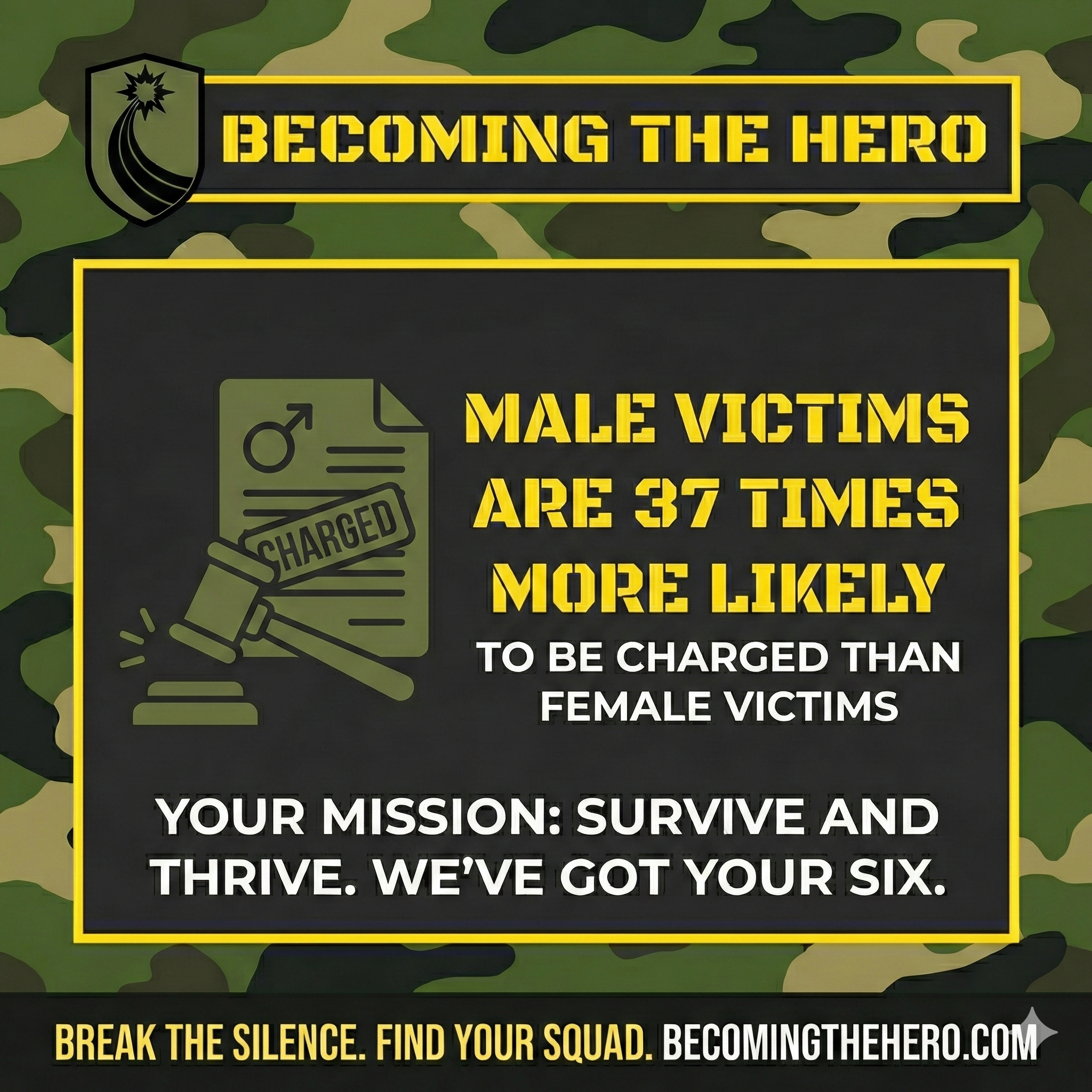
It triggers the system against you. When a man yells, shoves, or becomes visibly angry during a DV incident, responding officers are far more likely to identify him as the primary aggressor — regardless of what provoked the reaction. Male victims are 37 times more likely to be charged than female victims when no injuries are present (Millar & Brown, 2010 cited in Roebuck, Pathe, & Frkovic, 2020). Your reaction becomes the basis for your arrest.
It feeds the “he’s the real abuser” narrative. 40.2% of men who sought help from DV agencies were accused of being the batterer (Douglas & Hines, 2011). If she’s told the agency, the hotline, or the police about your reaction — without mentioning her sustained pattern of abuse — the system will see you as the perpetrator. Your reaction is presented without context, and context is everything.
It destroys your credibility in court. In custody and protection order proceedings, a single documented incident of your reactive behavior can outweigh months of her documented abuse — because the court system, like the police, often defaults to the assumption that the man is the aggressor. False accusations combined with evidence of your reaction creates a narrative that is extremely difficult to overcome.
It keeps you trapped. The guilt from reactive abuse is the single most effective tool an abuser has for keeping a man in the relationship. As long as you believe your reaction makes you just as bad, you won’t leave, you won’t tell anyone, and you won’t seek help. That guilt is not a sign that you’re an abuser. It’s a sign that you’re a good person who was pushed into doing something that conflicts with your values.
She knows all of this. The provocation is not accidental. She understands — consciously or instinctively — that your reaction gives her power. It gives her evidence, it gives her leverage, and it gives her the one thing every abuser needs: your silence.
The guilt you feel is not proof that you’re the abuser. It’s proof that you’re not. Abusers don’t lose sleep over their behavior. You do.
WHAT YOU CAN DO
1. Recognize the pattern.
The first step is understanding that what’s happening to you has a name and a mechanism. You are not “just as bad.” You are not in a “mutually toxic relationship.” You are a person who has been systematically provoked into reacting — and that reaction has been weaponized against you.
2. Stop engaging.
This is easier said than done — and it’s not your fault that it’s hard. But when she escalates, your best response is to disengage. Leave the room. Leave the house. Say nothing. The less you react, the less ammunition she has. She will likely escalate further to get the reaction she needs — be prepared for that, and leave anyway.
3. Document the provocation, not just the reaction.
If you’re documenting incidents — and you should be — record the full sequence: what she did first, how long it went on, what she said, and then what you did. Context matters, and your documentation is the only place that context will exist. She will only present the ending. You need to present the whole story.
4. Tell your therapist.
A good therapist will understand reactive abuse and will not treat your reaction as evidence that you’re an abuser. If your therapist suggests you’re the primary aggressor based on your reaction without exploring the full context of the abuse, find a different therapist. You deserve someone who understands the difference.
5. Forgive yourself.
You reacted. You’re human. That reaction does not define you, it does not cancel out what she did to you, and it does not mean you deserve to be abused. The shame you carry is her weapon. Putting it down is yours.
PROFESSIONAL NOTE
A Note for Therapists, Officers, and Advocates
If you work with DV cases — as a clinician, a law enforcement officer, or an advocate — reactive abuse should be part of your assessment framework.
When a man presents with guilt about his own behavior in the relationship, the instinct in many systems is to classify him as a perpetrator. But guilt is a clinical indicator that should trigger further assessment, not a confirmation of the initial assumption.
Ask about the full pattern. Ask what preceded the reaction. Ask whether the behavior is systematic and controlling or isolated and shame-driven. Ask who initiates the escalation. Ask who feels guilty afterward.
The answers will tell you who the primary aggressor is — and it is often not the person who yelled.
Misidentifying a reactive abuse victim as a perpetrator doesn’t just fail him. It empowers the actual abuser and removes the victim’s last remaining support. The consequences — arrest, loss of custody, loss of credibility — can be irreversible.
Get it right. It matters.
RESOURCES
Crisis support:
- National Domestic Violence Hotline: 1-800-799-7233 (call) or text START to 88788
- Crisis Text Line: Text HOME to 741741
- 988 Suicide and Crisis Lifeline: Call or text 988
- If in immediate danger, call 911
On this site:
- IS IT ABUSE?— if you’re still assessing what’s happening
- PLAN A SAFE EXIT — the full guide to building your exit plan
- THE HERO’S JOURNEY — you’re not a victim. You’re a hero.
YOU ARE NOT THE VILLAIN
She told you that you are. The system may have told you that you are. You may have told yourself that you are.
But a villain doesn’t lie awake at night feeling guilty. A villain doesn’t search the internet wondering if he’s the problem. A villain doesn’t read a page like this hoping someone will tell him he’s not as bad as he thinks he is.
You’re not the villain. You never were.
You’re a man who was pushed past his breaking point by someone who needed you to break — so she could point at the pieces and say “look what he did.”
You’re not broken. You reacted. And now you know what it was.
Let it go. And start becoming the hero.
All statistics on this page are sourced from federal government surveys or peer-reviewed, published research. Full citations are available on our References page. We encourage independent verification of every number presented here.