LAW ENFORCEMENT
You respond to domestic calls every shift. This page is about the ones you might be getting wrong.
Domestic violence calls are among the most dangerous and complex situations officers face. You already know that. What you may not know is how often the person you’re identifying as the perpetrator is actually the victim — and how the tools you’ve been trained to use may be driving that error.
Male victims of intimate partner violence report to police at nearly the same rate as female victims — 49.4% vs. 53.8% (Bureau of Justice Statistics, 2019–2024). They are reaching out to you. The question is what happens when you arrive.
The research on that question is not encouraging. But it is fixable — and it starts with understanding what the data actually shows about male victims, female perpetrators, and the assumptions embedded in current response protocols.
You may be the only one who can protect him. This page will help you be ready.
THE POLICE RESPONSE
What’s Happening on These Calls
When male victims call the police for help, the outcomes are dramatically different from those experienced by female victims.
Police inaction:
- Approximately 40% of men who called police reported that the police “did nothing” (Douglas & Hines, 2011).
- 25.4% reported being ignored or dismissed by responding officers (Douglas & Hines, 2011).
Victim arrested:
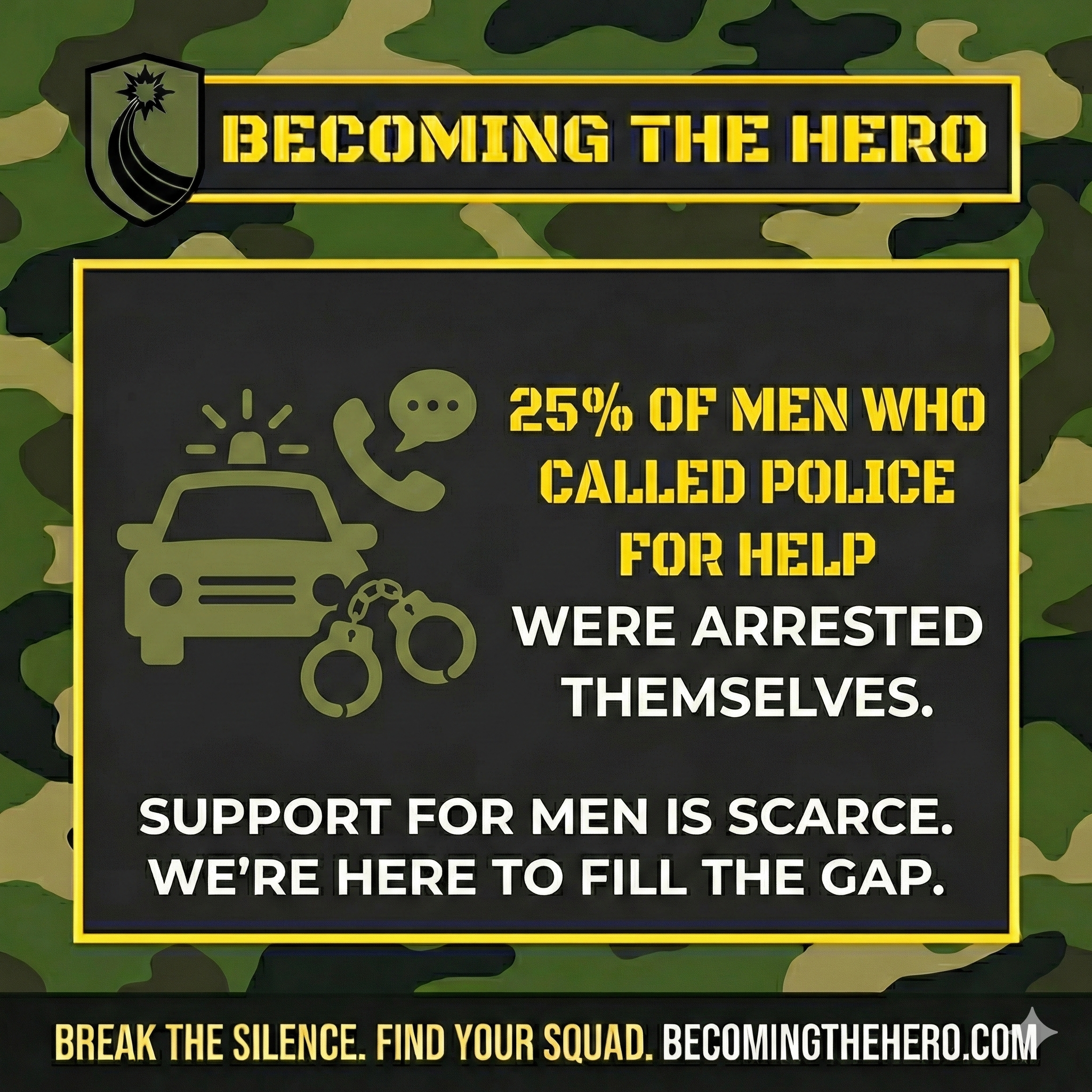
- 25% of men who called police for help were arrested themselves (Hall, 2016).
- 64% of male survivors who called police in a Canadian study reported being treated as the abuser (Dutton, 2012 cited in Roebuck, Pathe, & Frkovic, 2020).
Charging disparities:
- Male victims are 37 times more likely to be charged than female victims in cases where no injuries are present (Millar & Brown, 2010 cited in Roebuck, Pathe, & Frkovic, 2020).
- Injured male victims are charged 16% of the time, compared to only 1% of injured female victims (Roebuck, Pathe, & Frkovic, 2020).
Dual arrest patterns:
- Dual arrests — arresting both parties — were 56% less likely when the offender was male, indicating police are more inclined to hold males solely responsible even when the female partner is also violent (Hirschel & Deveau, 2016).
- In states with primary aggressor statutes, the likelihood of any arrest decreased by nearly a third — suggesting officers choose to arrest no one rather than determine a female primary aggressor (Hirschel & Deveau, 2016).
The pattern is clear: when a man calls for help, the system is more likely to treat him as the problem than to protect him as the victim.
25% of men who called police for help were arrested themselves.
Male victims are 37 times more likely to be charged than female victims when no injuries are present.
WHY OFFICERS GET IT WRONG
This is not about blaming individual officers. It’s about identifying the structural factors that produce bad outcomes — so they can be corrected.
Size and strength bias. Officers arriving on scene often default to the assumption that the larger, stronger person is the aggressor. This assumption has no basis in DV research. Abuse is defined by patterns of power and control, not physical size. A woman who controls the finances, makes false accusations, weaponizes custody, and throws objects at her partner is the primary aggressor — regardless of the size differential. Female perpetrators frequently use weapons or household objects to compensate for physical differences; one study found weapon use was higher in incidents targeting men (12%) than women (4%) (Mahony, 2010 cited in Roebuck, Pathe, & Frkovic, 2020).
Visible injury bias. Officers are trained to assess for visible injuries, which often drives the determination of who is the victim and who is the aggressor. But visible injury is a poor proxy for who initiated the violence. A man who has been punched, scratched, or hit with an object may show minimal bruising due to body composition, while a woman who injured herself during an attack — or who was restrained by the man defending himself — may present with more visible marks. Systems that rely on visible injury to classify severity systematically undercount violence by female perpetrators.
The “tears” dynamic. Multiple studies document that female perpetrators deliberately manipulate the emotional presentation on scene — crying, appearing frightened, or claiming to be the victim — knowing that officers are more likely to believe a distressed woman than a calm or frustrated man (Dim & Lysova, 2021). Men who have been abused for months or years may present as flat, angry, or shut down — not because they are the aggressor, but because they are exhausted and have learned that showing emotion makes things worse.
Training rooted in the Duluth Model. Most law enforcement DV training is based on the Duluth Model, which frames domestic violence as a pattern of male power and control over women. This framework was not designed to account for female-perpetrated violence and creates a cognitive bias in which male = perpetrator and female = victim before the officer has assessed the facts. When training teaches officers to look for a male aggressor, that is what they find — even when the evidence points elsewhere.
Mandatory arrest policies. In jurisdictions with mandatory or pro-arrest policies, officers must make an arrest when there is probable cause of DV. When the framework and training default to “male aggressor,” mandatory arrest becomes a mechanism that punishes male victims for calling the police. This is the single most cited reason men give for not reporting: they know that calling for help may result in their own arrest (Dim & Lysova, 2021).
PRIMARY AGGRESSOR IDENTIFICATION
Correctly identifying the primary aggressor is the most critical decision an officer makes on a DV call. Getting it wrong doesn’t just fail the victim — it empowers the abuser and can result in the victim losing his children, his home, and his freedom.
Primary aggressor laws exist in most states to prevent dual arrests and to ensure that the person who poses the greatest ongoing threat is the one held accountable. But these laws only work if officers apply them based on evidence, not assumptions.
What to assess:
1. History of violence — not just tonight’s incident. Who has a documented pattern? Prior calls to the same address, prior protective orders, and witness statements matter more than who has a bruise right now. Ask both parties about the history, separately.
2. Who is afraid of whom? Fear is the clearest indicator of the victim. The primary aggressor is the person the other party is afraid of — not the person who is larger, louder, or more visibly upset. A man who is calm or flat on scene may be exhibiting learned helplessness, not indifference.
3. Defensive vs. offensive injuries. Scratches on a man’s arms and face may be offensive (she attacked him) rather than defensive (he restrained her). Scratches on a woman’s wrists may be defensive (he grabbed her wrists to stop being hit). Assess the type and location of injuries, not just who has more of them.
4. Who called? The person who called 911 is more likely to be the victim. A perpetrator who is in control of the situation rarely invites law enforcement into it. If the man called, take that seriously as an indicator.
5. Coercive control indicators. Ask about patterns beyond physical violence: Does one partner control the finances? Make threats about custody? Monitor the other’s phone or movements? Make false reports to authorities? These are indicators of the primary aggressor that physical evidence alone will not reveal.
6. Children’s behavior. If children are present, observe their reactions. Do they cling to one parent? Do they seem coached? Are they afraid of one parent specifically? Children’s behavior on scene can be a powerful indicator of the ongoing dynamic in the home.
What NOT to use as a primary aggressor indicator:
- Gender
- Who is bigger or stronger
- Who is calmer on scene (calm may indicate learned helplessness, not control)
- Who is crying (emotional presentation can be manipulated)
- Who has more visible injuries (injury severity is a poor proxy for who initiated violence)
In states with primary aggressor statutes, the likelihood of any arrest decreased by nearly a third — suggesting officers choose to arrest no one rather than identify a female primary aggressor.
FALSE ACCUSATIONS
False Accusations and Weaponized Systems
One of the most significant barriers to effective law enforcement response is the deliberate manipulation of legal systems by abusive partners. This is not a fringe scenario — it is a documented pattern.
- Among men experiencing female-perpetrated violence, 56% reported their partners made false accusations of physical or sexual abuse against them (George Mason University, 2022).
- In help-seeking samples, 91.4% of men reported experiencing some form of “legal and administrative aggression” — including false reports to police, false accusations of child abuse, and manipulation of protective order processes (Hines, Douglas, & Berger, 2015).
- Male victims report that their abusive partners threaten to call the police as a control tactic — knowing that officers are more likely to arrest the man regardless of the circumstances (Dim & Lysova, 2021).
- Judges were found to be almost 13 times more likely to grant a restraining order requested by a female plaintiff against a male partner than one requested by a male plaintiff against a female partner (Muller et al., 2009 cited in Hobbs, 2023).
When officers respond to a call and find a woman claiming to be the victim, the possibility that she is the aggressor who called the police as a tactic should be part of the assessment — not dismissed as implausible.
THE EVIDENCE
Evidence Collection for Male Victims
When a male victim is correctly identified, proper evidence collection protects both the victim and the integrity of the case. Male victims present differently, and evidence protocols should account for that.
Document thoroughly:
- Photograph all injuries, including those that appear minor. Scratches, bite marks, and redness that may fade within hours should be captured immediately.
- Check non-visible areas. Men are less likely to report injuries to the torso, back, and groin — areas that clothing covers. Ask and document.
- Note weapon use or improvised weapons. Female perpetrators frequently use household objects — pans, bottles, phones, keys, hot liquids. Document the presence of any potential weapons on scene.
- Record the emotional state of both parties. A man who appears flat, detached, or “unemotional” may be exhibiting trauma responses — not indifference. Note this in the report as a potential indicator of prolonged abuse.
- Preserve digital evidence. Threatening texts, voicemails, emails, and social media posts are often the most compelling evidence in cases involving coercive control and legal aggression. Advise the victim to preserve these and note their existence in the report.
Interview separately and thoroughly:
- Interview both parties out of earshot and line of sight of each other.
- Ask open-ended questions about the history of the relationship, not just tonight’s events.
- Ask specifically about coercive control: financial control, isolation, monitoring, threats involving children, threats to make false reports.
- If children are present, interview them separately if age-appropriate.
Document the pattern, not just the incident:
A single DV call is often one data point in a long pattern. If prior calls exist at the same address, reference them. If the man reports a history of abuse, document that history even if it was not previously reported. The pattern is the case.
SYSTEMIC CHANGE
What Officers Can Do Differently
1. Apply primary aggressor criteria based on evidence, not appearance.
Use the assessment framework above. Size, gender, emotional presentation, and visible injury are unreliable indicators. History, fear, coercive control, and who called are far more accurate.
2. Take male callers seriously.
If a man called 911, he overcame enormous barriers to do so — including the knowledge that he might be arrested for making the call. That call is itself an indicator. Respond accordingly.
3. Know the law in your jurisdiction.
Understand how your state’s primary aggressor statute works, what criteria it requires, and how to document your determination. A well-documented primary aggressor finding protects you, protects the victim, and holds up in court.
4. Separate the “scene” from the “relationship.”
What you see in the first five minutes on scene is a snapshot. The abuse is a movie. Ask questions that reveal the longer pattern — who controls the money, who threatens custody, who monitors the phone, who has been isolated from support. That context changes everything.
5. Connect male victims to resources.
Carry or know the number for the National DV Hotline (1-800-799-7233) and local mental health crisis services. If your jurisdiction has no male-specific DV resources — and most don’t — a mental health referral is the single most effective connection you can make. 70.6% of male victims found mental health professionals helpful, compared to 33% for DV agencies (Douglas & Hines, 2011).
6. Advocate for better training in your department.
If your department’s DV training does not address male victimization, female perpetration, or gender-neutral primary aggressor assessment, raise it with your training division. The data supports the need. One wrongful arrest of a male victim is both a civil liability and a moral failure.
THERE IS A BIAS
Male victims report to police at nearly the same rate as female victims — 49.4% vs. 53.8%. They are reaching out. The question is what happens next.
RESOURCES
For him:
- National Domestic Violence Hotline: 1-800-799-7233 (call) or text START to 88788
- Crisis Text Line: Text HOME to 741741
- IS IT ABUSE? — our screening tool for men
- Refer to local mental health professionals — the most effective formal resource for male survivors
For your organization:
- THE STATISTICS — comprehensive federal data on male IPV victimization, arrest disparities, and system response
- REFERENCES — full citations for every study referenced on this site
- CONTACT US — to discuss training or consultation for your department
THE MISSION
Protect and Serve. All of Them.
You took an oath to protect people — not categories of people. The man standing in front of you on a domestic call, who is quiet, who isn’t crying, who maybe has a scratch on his arm and a partner sobbing behind him — he may be the one who needs your protection.
The data says you’ll get it wrong about a quarter of the time. This page exists to help you get it right.
All statistics on this page are sourced from federal government surveys or peer-reviewed, published research. Full citations are available on our References page. We encourage independent verification of every number presented here.