DV SHELTERS & AGENCIES
The data shows you are failing male survivors. You already do the work. Now do it for everyone.
If you work in domestic violence services, you chose this field because you believe survivors deserve safety, support, and a path forward. This page isn’t here to challenge that belief. It’s here to expand it.
The domestic violence sector has built an extraordinary infrastructure for female survivors over the past fifty years. That work has saved lives and it continues to matter. But the same data that drives funding, training, and policy for women also documents a population that the system was never designed to serve — and in many cases, actively turns away.
Men account for nearly half of all intimate partner violence victims in behavioral surveys (Leemis et al., 2022). Yet only 9.8% of male IPV victims receive any form of victim services — compared to 25.9% of female victims (Bureau of Justice Statistics, 2019–2024). The gap is not in the need. It’s in the response.
This page presents what the research shows about male survivors’ experiences with DV agencies, what’s going wrong, and what your organization can do differently — without reducing services to women.
You may be the only resource available to him. This page will help you be ready.
THE MALE EXPERIENCE
What Male Survivors Experience When They Call
The most comprehensive study of male help-seeking from DV services comes from Douglas & Hines (2011), surveying 302 men who had sustained IPV from female partners and sought help. Their findings have been replicated and expanded across multiple countries (Hines, Lysova, & Douglas, 2025). The picture is consistent:
Refused service outright:
- 63.9% of men who contacted a DV hotline were told “we only help women.”
- 49.9% of men who contacted a DV agency were told the same.
Misidentified as the perpetrator:
- 40.2% of men who sought help from a DV agency were accused of actually being the batterer.
- 32.2% of men who contacted a hotline were accused of being the batterer.
Referred to abuser programs:
- Over 25% of men who used online DV resources were given a phone number for a batterer’s intervention program — when they were the victim seeking help.
Ridiculed:
- 16.4% of men who contacted hotlines reported being ridiculed by the staff they spoke with.
Rated unhelpful:
- Approximately 67% of men rated DV agencies and hotlines on the “not at all helpful” end of the scale — an average rating of 2.68 out of 5.
- By contrast, agencies specifically designed for male victims were rated significantly higher at 3.23 out of 5 (Hines, Lysova, & Douglas, 2025).
These are not isolated incidents. This is a systemic pattern documented across the United States, Canada, the United Kingdom, and Australia.
63.9% of men who called a DV hotline were told “we only help women.” 40.2% who contacted a DV agency were accused of being the abuser.
THE SHELTER GAP
The physical infrastructure for male DV survivors is virtually nonexistent.
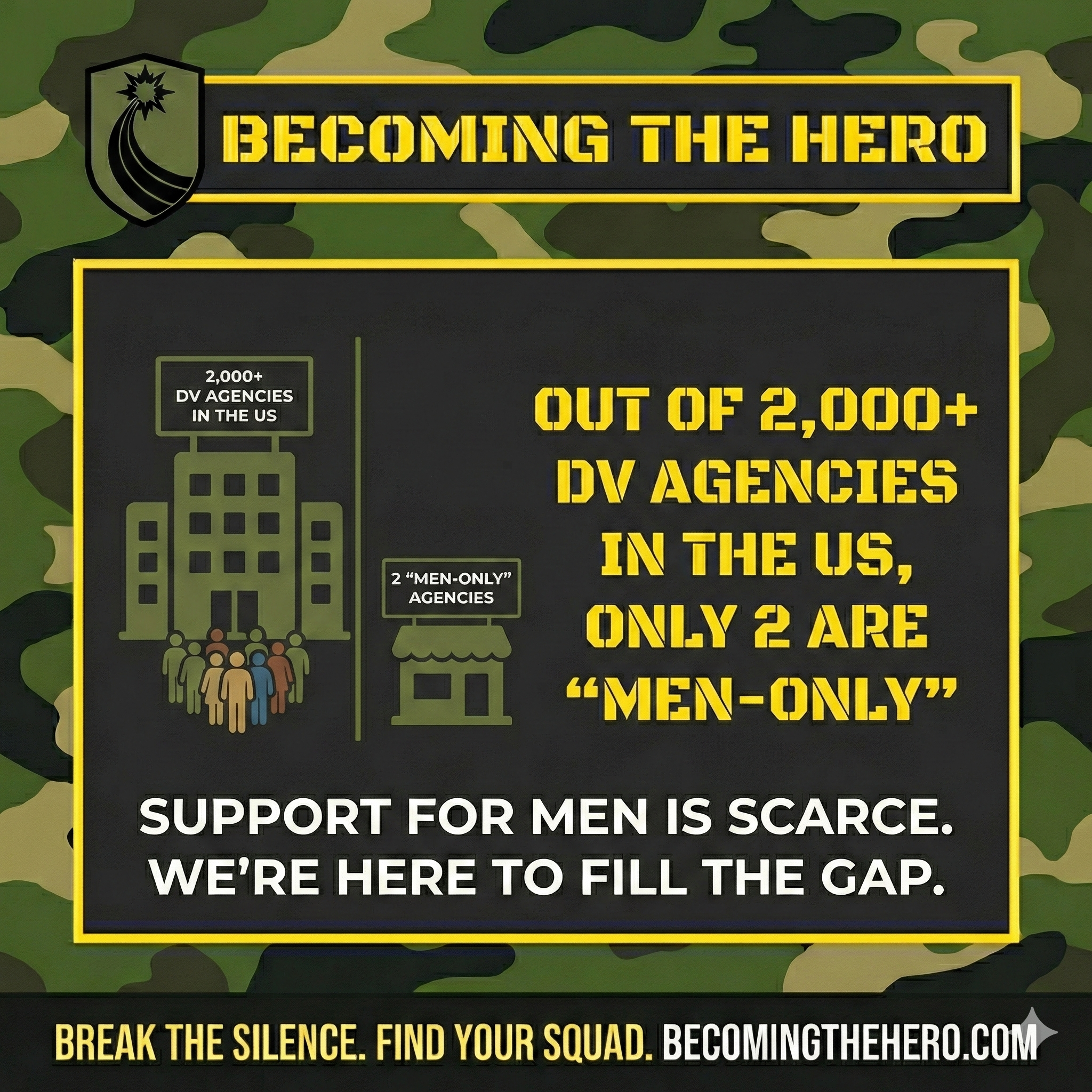
- United States: There are approximately 2,000 DV agencies and hotlines nationwide. As of 2025, only two shelters are dedicated specifically to male victims (Hines, Lysova, & Douglas, 2025).
- United Kingdom: 37 organizations provide dedicated shelter spots for men, offering a total of 40 spaces — compared to thousands for women (Hines, Lysova, & Douglas, 2025).
- Northern Ireland: There are currently zero domestic abuse shelters for male victims (Commissioner for Victims of Crime Northern Ireland, 2024).
- Canada: The first dedicated shelter for male DV victims opened in 2021 (Hines, Lysova, & Douglas, 2025).
BECOMING HOMELESS
When men are turned away from shelters, the alternatives are grim: homelessness, sleeping in cars, returning to the abuser, or — in the worst cases — losing custody of their children because they have no stable housing.
WHY IS THIS HAPPENING?
The exclusion of male survivors from DV services is not the result of individual bias alone. It reflects structural and ideological factors embedded in the field:
The Duluth Model legacy. The dominant framework for DV intervention in the United States — the Duluth Model — was designed around the premise that domestic violence is a pattern of male power and control over women. This framework has shaped intake protocols, training curricula, funding requirements, and organizational culture for decades. When a male victim walks through the door, the system built on this model has no category for him — except “perpetrator.”
Funding structures. Many DV agencies receive federal and state funding tied to the Violence Against Women Act (VAWA). While VAWA is technically gender-neutral in its victim provisions, its name, its legislative history, and its implementation have created a funding ecosystem that overwhelmingly serves female victims. Agencies that want to serve men may fear jeopardizing their funding by appearing to dilute their mission.
Intake and screening bias. Many intake forms, risk assessments, and screening tools were designed assuming a female victim and male perpetrator. Questions about “your abuser” may default to male pronouns. Safety planning protocols may assume the victim is physically smaller than the perpetrator. These tools don’t just fail to capture male victimization — they actively erase it.
Staff training gaps. Frontline staff at DV agencies are often trained in frameworks that center female victimization. Without specific training on male survivors, staff may default to skepticism, disbelief, or the assumption that a man presenting as a victim is actually the abuser engaging in a manipulation tactic. This is the single most common complaint from male survivors who contact DV services (Douglas & Hines, 2011).
The “real victim” assumption. There is a persistent and documented belief within some DV organizations that male victims are either exaggerating, lying, or attempting to gain tactical advantage in custody disputes. While false reports exist in any population, research shows that men who seek help from DV services report levels of violence and control comparable to or exceeding those of women in shelter populations (Hines & Douglas, 2010).
Male help-seekers report levels of violence and control comparable to or exceeding those of women in shelter populations.
WHERE MEN ACTUALLY GET HELP
The data shows a clear pattern: men avoid DV-specific services and rely on generalist providers and informal networks instead.
Mental health professionals are the most effective formal resource for male survivors:
- 66.2% of help-seeking men sought help from a mental health professional (Douglas & Hines, 2011).
- 70.6% found them “somewhat” or “very” helpful (Douglas & Hines, 2011).
- 68% reported that mental health professionals took their concerns seriously (Douglas & Hines, 2011).
Informal support is the most utilized:
- 84.9% of help-seeking men turned to friends, relatives, or attorneys (Douglas & Hines, 2011).
DV agencies are the least helpful formal resource:
- Men consistently rate DV agencies lower than every other source of support — including doing nothing (Douglas & Hines, 2011).
The implication is uncomfortable but clear: the DV sector, as currently structured, is the least trusted and least effective resource for nearly half of the population it is mandated to serve.
WHAT YOUR ORGANIZATION CAN DO
None of this requires defunding women’s services or dismantling existing programs. It requires expanding your definition of who a survivor is — and building the infrastructure to match.
1. Audit your intake process.
Review your intake forms, screening tools, and assessment protocols for gendered language and assumptions. Do your forms assume a male perpetrator? Do your safety planning protocols assume the victim is physically smaller? Do your staff default to skepticism when a man presents as a victim? A simple language and process audit can reveal barriers you didn’t know existed.
2. Train staff on male victimization.
Invest in training that specifically addresses:
- The prevalence and severity of female-perpetrated IPV
- How male survivors present differently (minimization, humor, anger instead of fear)
- Legal and administrative aggression as a form of abuse
- The risk of misidentifying male victims as perpetrators
- How to conduct a gender-neutral primary aggressor assessment
3. Create a referral pathway for men.
If your agency cannot serve men directly, build a vetted referral list of providers who can — including male-friendly therapists, family law attorneys with experience in male custody cases, and any local organizations that accept male clients. A referral is infinitely better than “we only help women.”
4. Review your physical environment.
If your shelter or office space is designed exclusively for women and children, consider what message that sends to a male survivor who walks through the door. Even small changes — gender-neutral signage, separate intake spaces, male staff availability — can signal that men are welcome.
5. Advocate for inclusive funding.
Push back on the assumption that serving men means taking resources from women. Advocate within your funding networks for expanded allocations that recognize male victimization as a legitimate and documented need. The data supports it — the political will needs to catch up.
6. Stop treating male callers as potential perpetrators.
This is the single highest-impact change your organization can make. When a man calls your hotline or walks through your door, the default assumption should be the same as it is for any other person seeking help: that he is telling the truth until evidence suggests otherwise. The research is clear that male help-seekers experience levels of abuse that mirror or exceed those of women in shelters (Hines & Douglas, 2010; Hines & Douglas, 2015).
FEMALE PERPETRATORS
The Treatment Gap for Female Perpetrators
There is a related gap that directly affects male survivors and that DV organizations are uniquely positioned to address: the near-total absence of intervention programs for female perpetrators.
- Stakeholders report a significant lack of both statutory and non-statutory treatment programs for women who perpetrate intimate partner violence (Barton-Crosby & Hudson, 2021).
- Female perpetrators are sometimes referred to victim support programs rather than accountability programs — because appropriate perpetrator intervention services for women simply do not exist (Barton-Crosby & Hudson, 2021).
- While female offenders in the justice system often receive trauma-informed care that frames their behavior through the lens of prior victimization, the same consideration is rarely extended to male offenders — creating an inequity in how accountability and rehabilitation are applied (Barton-Crosby & Hudson, 2021).
Failing to provide intervention programs for female perpetrators doesn’t just harm male victims. It harms the women themselves by denying them the opportunity to address and change their abusive behavior. It also harms the children who witness the abuse and internalize its patterns.
A complete DV response serves all victims and holds all perpetrators accountable — regardless of gender.
THERE IS A MAJOR NEED
Only 9.8% of male IPV victims received any form of victim services. 90% received no help at all.
RESOURCES
For him:
- National Domestic Violence Hotline: 1-800-799-7233 (call) or text START to 88788
- Crisis Text Line: Text HOME to 741741
- IS IT ABUSE? — our screening tool for men
- Refer to local mental health professionals — 70.6% of men found them helpful vs. 33% for DV agencies
For your organization:
- THE STATISTICS — comprehensive federal data on male IPV victimization and service gaps
- REFERENCES — full citations for every study referenced on this site
- CONTACT US — to discuss training, consultation, or referral partnerships
If you’re worried about his immediate safety or the safety of his children, encourage him to call the hotline or reach out to a local mental health professional. Unlike DV agencies, 70.6% of men found mental health professionals helpful and willing to take their concerns seriously (Douglas & Hines, 2011).
THE MISSION
The Mission Doesn’t Change. It Expands.
You became a DV professional because you believe that no one deserves to be abused and that every survivor deserves help. This page is asking you to apply that belief without a gender qualifier.
The men who call your hotline, who walk through your door, who sit in your waiting room trying to find the words — they are survivors too. They deserve the same assumption of honesty, the same access to safety, and the same shot at healing.
The mission doesn’t change. It just gets bigger.
All statistics on this page are sourced from federal government surveys or peer-reviewed, published research. Full citations are available on our References page. We encourage independent verification of every number presented here.