WHY MEN STAY
You’re not stupid. You’re not weak. You’re trapped by a system that was never built for you.
If you’ve ever asked yourself “why can’t I just leave?” — this page is for you.
The answer isn’t simple, and it isn’t a reflection of your character. The reasons men stay in abusive relationships are documented in research, reported by thousands of survivors, and rooted in real barriers — not personal failure.
The people around you may not understand. They see a man who’s bigger, stronger, who earns a paycheck, and they think: “If it were really that bad, you’d just walk out.” They don’t see what you see. They don’t know what you know.
You know what happens if you leave.
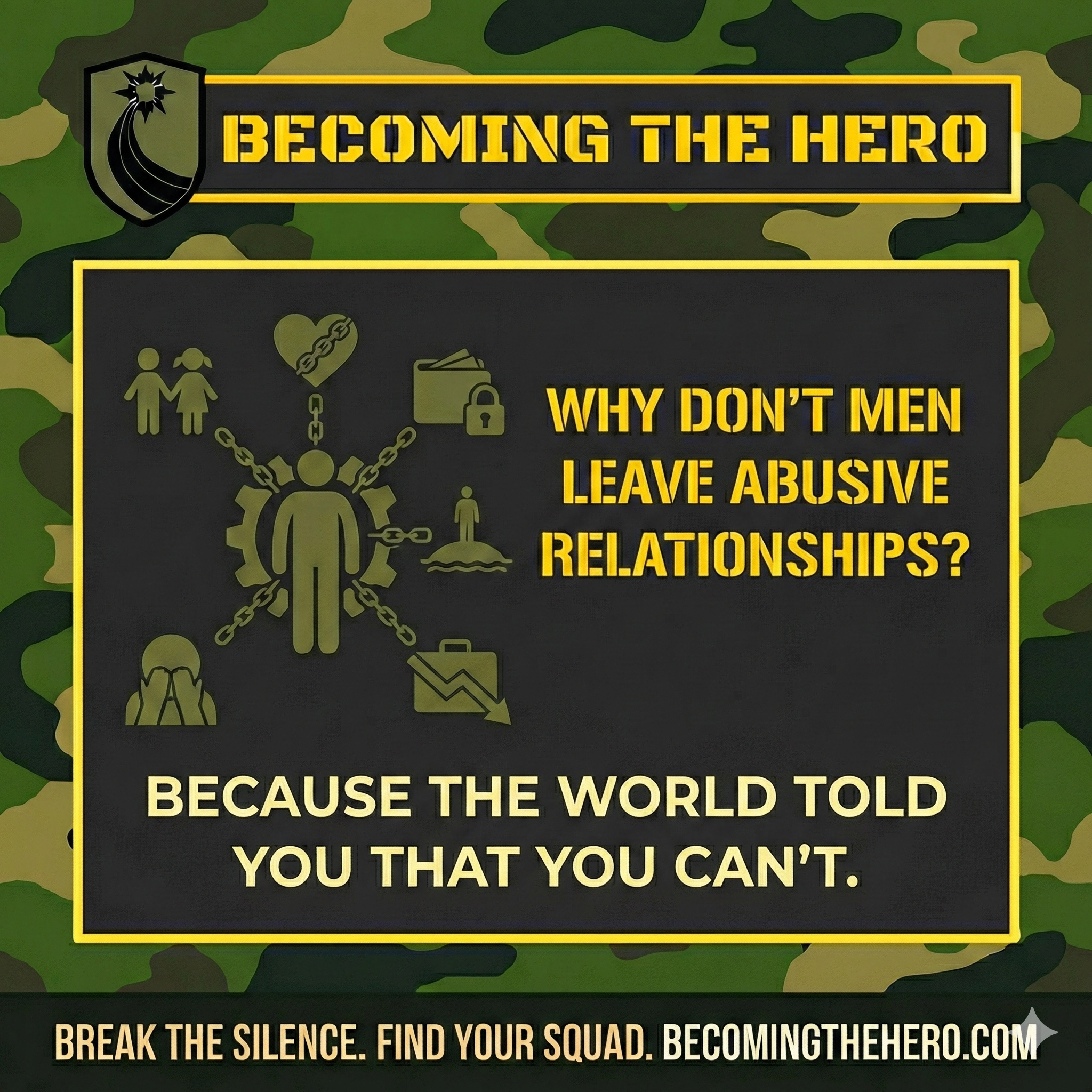
THE BARRIERS ARE REAL
Your children.
This is the one. For most men, this is the reason — the only reason that matters.
You know that if you leave, there is a very real chance the courts will give her primary custody. Not because she’s a better parent. Not because she’s safer. Because the system defaults to mothers, and you know it (Hines & Douglas, 2010; Hall, 2016).
You’ve done the math. If you leave and she gets the kids, who protects them? Right now, you’re the buffer. You stand between her and them. You absorb the anger so they don’t have to. You stay because leaving feels like abandoning the people you’re trying to save.
Men report staying specifically to protect their children from the abuser — acting as a shield between the abusive partner and the kids (Commissioner for Victims of Crime Northern Ireland, 2024). You’re not staying because you’re weak. You’re staying because you’re a father.
That instinct is noble. But it has a cost — and the cost is you.
The financial trap.
She may control the money. She may have destroyed your credit. She may have run up debt in your name, sabotaged your employment, or created a financial situation where you literally cannot afford to maintain two households — mortgage, child support, your own rent, and groceries (Hine et al., 2022).
91% of male DV victims in one study had left or lost a job in the previous year as a direct result of violence in the home (Swanberg et al., 2006 cited in Hall, 2016). When she calls your workplace twenty times a day, shows up at your office, or creates a crisis every time you have a deadline — that’s not coincidence. That’s financial sabotage. It’s a documented form of coercive control designed to keep you dependent (Hines et al., 2015).
59% of male survivors in a Canadian sample experienced financial or economic abuse (Roebuck, Pathe, & Frkovic, 2020). If you feel like you can’t afford to leave, that may be by design.
There’s nowhere to go.
There are approximately 2,000 domestic violence agencies and hotlines in the United States. As of 2025, two of them — two — are dedicated shelters for male victims (Hines, Lysova, & Douglas, 2025).
Two.
A woman who leaves an abusive relationship can call a hotline and be in a shelter bed that night. A man who leaves has a couch at a friend’s house — maybe. If he has friends left. If she hasn’t isolated him from everyone who might help.
In the United Kingdom, 37 organizations offer shelter for men — totaling 40 beds for the entire country (Hines, Lysova, & Douglas, 2025). In Northern Ireland, there are zero (Commissioner for Victims of Crime Northern Ireland, 2024). The infrastructure does not exist. You’re not imagining that. It’s a fact.
52 million men in the United States have experienced intimate partner violence. There are two shelters. You’re not failing to find help. The help doesn’t exist.
You still love her.
This is the one nobody wants to talk about, but it’s real.
You remember who she was before. Or who she is between the bad times. You see her pain, her mental health struggles, her trauma — and you think if you just love her enough, if you’re patient enough, if you say the right thing, she’ll get better. You married her. You made a commitment. Walking away feels like giving up on someone who needs help (Hines & Douglas, 2010).
This is not weakness. It’s loyalty. It’s the same quality that makes you a good father, a good friend, a good man. But loyalty to someone who is hurting you is not the same as love. And staying to fix someone who won’t fix herself is not commitment — it’s captivity.
The shame.
Admitting that you — a man — are being abused by a woman requires you to say something that every message you’ve ever received about masculinity tells you is impossible. Men are strong. Men protect. Men endure. Men don’t get abused.
So you don’t call it abuse. You call it a “difficult relationship.” You call it “her temper.” You call it “things getting out of hand.” You minimize, rationalize, and reframe because the alternative — saying “my wife beats me” or “my girlfriend controls every aspect of my life” — feels like admitting you’ve failed at being a man (Hall, 2016).
The shame of being an abused man is compounded by the shame of a “failed” marriage, the shame of what your family will think, and the very real fear that people will laugh. 49% of male victims cited fear of not being taken seriously as a primary reason for not seeking help (Drijber et al., 2013). You’re not paranoid. The data says they won’t take you seriously. And you know it.
The system will make it worse.
You’ve thought about calling the police. Then you thought about what happens when they arrive. You know the statistics even if you’ve never read them: 25% of men who call police for help are arrested themselves (Hall, 2016). You know she’ll cry. You know she’ll tell them you’re the one who did it. You know how that looks.
You’ve thought about calling a hotline. 63.9% of men who called DV hotlines were told “we only help women” (Douglas & Hines, 2011). 40.2% of men who contacted DV agencies were accused of being the batterer (Douglas & Hines, 2011).
You’ve thought about going to court. Judges are almost 13 times more likely to grant a restraining order to a woman against a man than to a man against a woman (Muller et al., 2009 cited in Hobbs, 2023). 56% of men experiencing female-perpetrated violence report that their partners made false accusations against them to authorities (George Mason University, 2022).
You’re not paranoid. The system is not designed for you. Every exit you can think of has a trap behind it.
The question is never “why does he stay?” The question is “what would happen if he left?” When every exit leads to losing your children, your home, your freedom, or your reputation — staying starts to look rational.
WHAT STAYING COSTS YOU
You already know this part. You live it every day.
Staying costs you your health. 57.9% of help-seeking men met the clinical threshold for PTSD — a rate comparable to battered women in shelters (Hines & Douglas, 2011). You may not call it PTSD. You may call it insomnia, or the knot in your stomach when you hear her car pull in, or the way you flinch when someone moves too fast. But your body is keeping score.
Staying costs you your identity. The longer you stay, the more of yourself you lose. Your friendships shrink. Your confidence erodes. You start to believe the things she says about you — that you’re worthless, that no one else would want you, that everything is your fault. Coercive control doesn’t just trap your body. It rewrites your mind.
Staying costs your children too. You stayed to protect them. But they’re watching. They’re learning that this is what a relationship looks like. They’re learning that love means enduring pain. The buffer you’re providing is real — but the lesson they’re absorbing is real too.
And staying costs you time. Every year you stay is a year you don’t get back. The research on male help-seeking shows that the average DV victim attempts to leave seven times before leaving permanently. You may not be ready today. But knowing why you’re staying — really knowing — is the first step toward choosing differently when you are ready.
WHEN YOU’RE READY
This page is not here to tell you to leave. That decision is yours, and only you know when the time is right.
This page exists to tell you one thing: the reasons you’re staying are real, they are documented, and they do not mean you are weak.
You are facing a set of barriers — financial, legal, emotional, logistical, systemic — that would trap anyone. The fact that you’re still standing, still protecting your kids, still going to work, still reading this page — that’s not weakness. That’s endurance under conditions that would break most people.
When you’re ready — whether that’s tomorrow or next year — there are resources:
- Immediate Safety — if you need to act now
- Safety Planning — how to prepare before you leave
- Legal Rights — what you need to know about custody, protection orders, and documentation
- The Hero’s Journey — reframing your identity from victim to survivor to something more
- Path to Healing — finding a therapist who understands what you’ve been through
- Is It Abuse? — if you’re still not sure what to call it
You don’t have to do all of this at once. You don’t have to do any of it today. But know that when you’re ready, the path exists — and you’re not the first man to walk it.
IT’S NOT WEAKNESS
You’re Not Staying Because You’re Weak
You’re staying because the system gave you no safe way to leave. Because the shelters weren’t built for you. Because the courts don’t believe you. Because the hotlines hang up on you. Because your children need someone between them and her.
You’re staying because every option you can see leads to losing something you can’t afford to lose.
That’s not weakness. That’s a man doing the math in an impossible situation.
But the math can change. The barriers can be navigated. And you don’t have to figure it out alone.
When you’re ready, start with one page. One phone call. One conversation with someone you trust.
The first step is the hardest. But you’ve survived harder.
RESOURCES
Crisis support:
- National Domestic Violence Hotline: 1-800-799-7233 (call) or text START to 88788
- Crisis Text Line: Text HOME to 741741
- 988 Suicide and Crisis Lifeline: Call or text 988
- If in immediate danger, call 911
On this site:
- IS IT ABUSE?— if you’re still assessing what’s happening
- PLAN A SAFE EXIT — the full guide to building your exit plan
- THE HERO’S JOURNEY — you’re not a victim. You’re a hero.
All statistics on this page are sourced from federal government surveys or peer-reviewed, published research. Full citations are available on our References page. We encourage independent verification of every number presented here.