MEDICAL PROFESSIONALS
353,000 men came to your emergency departments with intimate partner violence injuries over 11 years. Almost none of them were asked about abuse.
If you work in emergency medicine, urgent care, or primary care, you have treated male victims of intimate partner violence. You may not have known it.
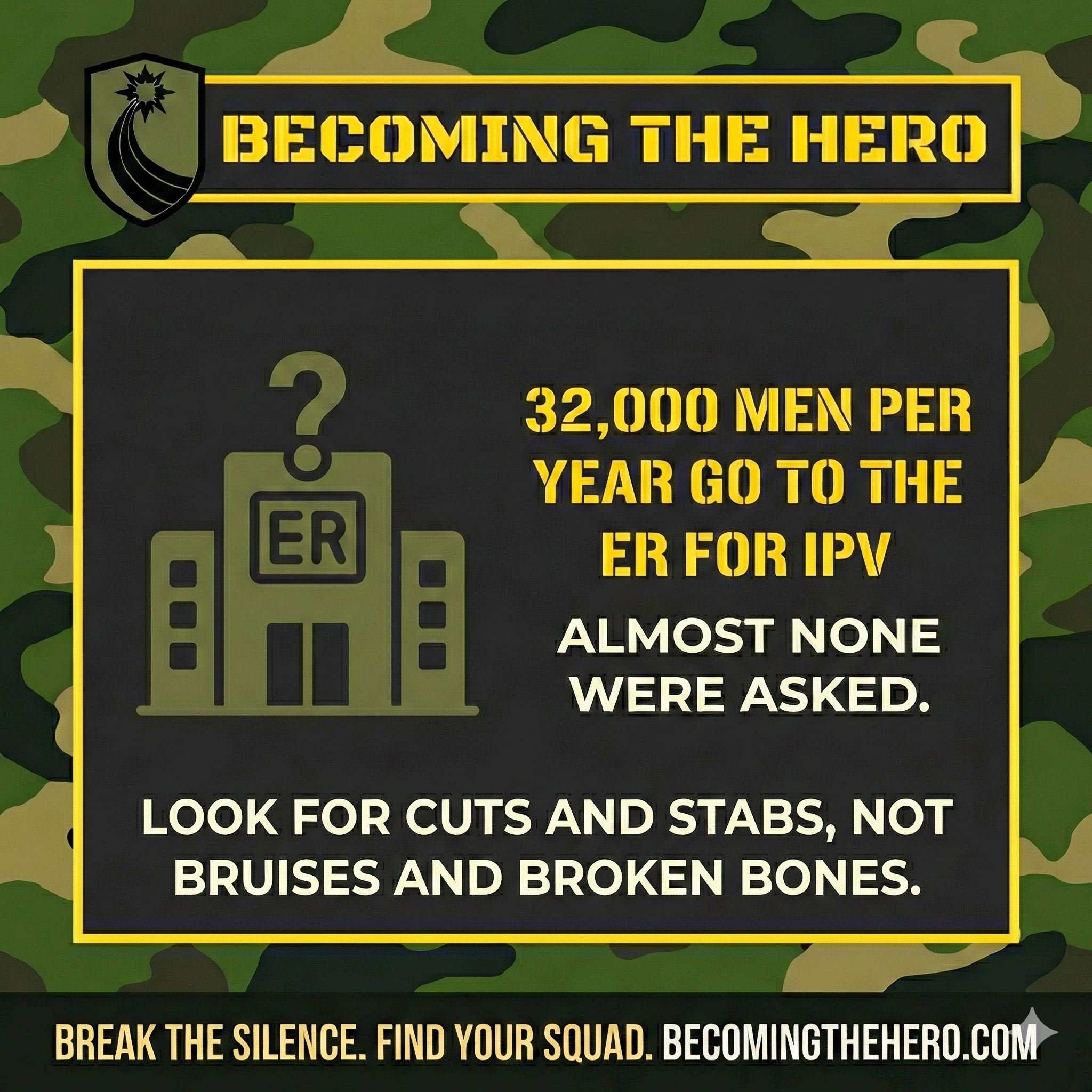
The largest study of IPV injury patterns in men — a nationwide analysis of over 2 million IPV-related emergency department visits from 2005 to 2015 — found that an estimated 353,382 men presented to U.S. emergency departments with injuries from an intimate partner (Khurana et al., 2022). That’s roughly 32,000 men per year walking through your doors with injuries caused by the person who shares their bed.
Most of them didn’t tell you the truth about how they got hurt. And most of them were never asked.
A UK study found that only 1.6% of men — including self-identified male IPV victims — had ever been asked by a healthcare professional about potential IPV victimization (Morgan et al., 2014). In the U.S., 91.8% of male IPV victims who saw a medical doctor for their injuries were asked about the cause — but only 60.4% were truthful, and only 14% were provided any IPV resources (Douglas & Hines, 2011).
The men are showing up. The injuries are real. The system is not catching them. This page is designed to change that.
IPV-Related ER Visits
The Numbers You Need to See
The following data comes from the National Electronic Injury Surveillance System–All Injury Program (NEISS-AIP), a weighted, stratified dataset managed by the U.S. Consumer Product Safety Commission designed to produce nationally representative estimates. This is not a sample — these are the extrapolated U.S. totals for 2005–2015 (Khurana et al., 2022).
IPV-Related Emergency Department Visits, United States, 2005–2015
| Category | Male Victims | Female Victims | Per Year (Male) |
|---|---|---|---|
| Total ED Visits | 353,382 | 1,706,058 | ~32,125 |
| Hospitalized | 27,000 | 61,508 | ~2,455 |
| Cut/Pierce Injuries | 98,856 | 58,998 | ~8,987 |
| Lacerations | 137,182 | 197,936 | ~12,471 |
| Fractures | 20,414 | 156,423 | ~1,856 |
| Bite Injuries | 20,639 | 20,277 | ~1,876 |
| Firearm/GSW | 3,089 | 3,861 | ~281 |
| Upper Extremity Injuries | 90,006 | 233,830 | ~8,182 |
| Head/Neck Injuries | 173,534 | 1,013,996 | ~15,776 |
Read the “Per Year (Male)” column. That’s approximately 9,000 men per year presenting to emergency departments with stab wounds and cutting injuries from intimate partners. 2,455 men per year hospitalized. 12,471 men per year with lacerations. These are not abstractions. These are your patients.
32,000 men per year. 2,455 hospitalized. 9,000 with cutting injuries. And only 14% received any IPV resources.
WHAT INJURIES TELL YOU
Male and female IPV victims present with distinctly different injury patterns. If your screening criteria are calibrated for female victims — which they almost certainly are — you are missing male victims. The Khurana et al. (2022) study identified several critical differences.
Lacerations, not contusions, are the marker for male IPV.
In female victims, the signature IPV injury is contusion/abrasion — bruising from being struck. In male victims, the most common injury is laceration (46.9% of all male IPV injuries vs. 13.0% in women). This reflects a fundamental difference in how violence is perpetrated against men: women are significantly more likely to use knives, sharp instruments, and objects (Cho & Wilke, 2010; Brown, 2004; Kernsmith & Craun, 2008).
If you are looking for bruises to identify male IPV, you will miss nearly half of them. Look for cuts.
Cutting injury rates are 8x higher in men — and more frequent in raw numbers.
98,856 men presented with cut/pierce injuries compared to 58,998 women — despite men representing only 17.2% of total IPV visits. Men were more likely than women to have been stabbed with a knife (6% vs. 1%), hit by a thrown object (10% vs. 3%), and hit by an object other than a gun (12% vs. 3%) based on NCVS data (Cho & Wilke, 2010). Women compensate for physical size and strength differences by using weapons (Chan et al., 2013; Purcell et al., 2021; Thureau et al., 2015).
Upper extremity injuries signal defensive wounds.
25.8% of male IPV injuries were to the upper extremity — arms, hands, and fingers — compared to 14.1% for women. In men, 68% of all upper extremity injuries were lacerations. The pattern — forearm lacerations, hand cuts, finger wounds — is consistent with a victim raising their arms and hands to block an attack from a sharp instrument (Khurana et al., 2021; Thomas et al., 2021). These are defensive injuries. Recognize them as such.
When men show up, they’re hurt worse.
Men were hospitalized at more than double the rate of women — 7.9% vs. 3.7% (p = .0002). The average male IPV patient was older than the average female patient (36.2 vs. 29.4 years). Men constituted more than one-third of all IPV victims over 60 years of age. The data supports what researchers call the “greater vulnerability/severity hypothesis” — men need additional vulnerabilities (such as age) or severity of injury to seek help at all (Khurana et al., 2022). The ones in your ED are the ones who couldn’t brush it off anymore.
Men only seek help when they can’t ignore it.
35.1% of male IPV victims in one study reported an injury severe enough to need medical attention. Only 18.1% actually went to a medical provider (Douglas & Hines, 2011). For every man you see in the ED with an IPV injury, there are roughly two more at home who needed to come in and didn’t.
Male vs. Female Injury Differences
Unlike women, a laceration — not a contusion — is the potential marker for IPV in men. If you’re screening for bruises, you’re missing the cuts.
WHY YOU’RE MISSING THEM
The failure to identify male IPV victims in medical settings is not a mystery. It is the predictable result of training, bias, and systemic design.
You weren’t trained to see it.
There are a variety of successful educational programs that train medical providers on screening, identifying, and providing treatment for women who experience IPV (Sprague et al., 2018). To the best of current knowledge, no such program includes men as victims — an omission that perpetuates the stereotype that IPV happens only to women and is perpetrated only by men (Khurana et al., 2022).
Preparedness drives screening — and you’re not prepared for this.
Research shows that among the factors contributing to medical providers screening for IPV among female patients, preparedness emerged as the key construct (Sprague et al., 2018). If you are unaware of the potential for IPV among your male patients and have not been provided any educational resources, you are unlikely to screen, identify, or provide treatment for men.
He won’t volunteer the information.
Men don’t disclose IPV for the same reasons they don’t disclose any vulnerability: fear of ridicule, shame, disbelief that what’s happening qualifies as abuse, and well-founded concern that they’ll be treated as the perpetrator (Douglas & Hines, 2011; Lysova et al., 2020; Bates, 2020). Medical providers who carry societal biases that IPV is something men do to women are likely to fail to ask more probing questions — or to reinforce men’s fears that they will be ridiculed or accused of being the aggressor (Eckstein & Cherry, 2015; Russell, 2018).
The result is a destructive cycle.
Men present with injuries. They are not asked about IPV. They are sent home without resources or a safety plan. The violence continues and escalates. They return with more severe injuries — or they don’t return at all. Nondetection by medical personnel perpetuates stigma and creates a cycle of repeated and escalating violence (Hope et al., 2021). A UK review of 22 domestic homicide cases where the man was the victim of female-perpetrated partner homicide found multiple missed opportunities by healthcare staff to follow up on serious injuries, including cases with multiple visits. Many of the men were never questioned alone and were never asked about IPV (Hope et al., 2021).
HOW TO SCREEN FOR MALE IPV
Identifying male IPV victims in medical settings does not require a new system. It requires adapting the system you already use.
Ask the question — of every patient.
Universal screening for IPV should include men. The majority of male IPV victims in a UK study — including self-identified victims — felt that universal or targeted screening was necessary (Morgan et al., 2014). They want to be asked. They are waiting for someone to ask.
Ask him alone.
Do not screen for IPV with a partner present. This applies to male patients exactly as it does to female patients. If his partner is in the room, he will not disclose. Many of the men in the Hope et al. (2021) homicide reviews were never questioned alone.
Use behaviorally specific language.
Do not ask: “Are you a victim of domestic violence?” Most men will say no — even men actively being abused — because they do not identify with that language.
Instead, ask:
- “Has your partner ever hit, pushed, shoved, cut, or thrown things at you?”
- “Has your partner ever threatened you with a weapon or object?”
- “Has your partner ever prevented you from leaving a room or your home?”
- “Do you feel safe at home?”
These behavioral questions bypass the identity barrier. A man who will never say “I’m a victim” may readily say “yes, she’s done that.”
Know what to look for.
Based on the Khurana et al. (2022) findings, the following injury patterns in a male patient should raise clinical suspicion for IPV:
- Lacerations — particularly to the head/neck and upper extremity — especially from sharp instruments
- Forearm lacerations — the most common defensive wound pattern in male IPV victims
- Hand and finger injuries — lacerations and fractures consistent with blocking attacks
- Injuries inconsistent with stated mechanism — the same red flag you already know from female IPV screening
- Repeat visits with unclear or changing injury explanations
- Older male patients — men over 60 represent more than one-third of all male IPV ED visits
Know the demographic risk factors.
In the NEISS-AIP data, Black men were significantly overrepresented among male IPV patients (40.5% vs. 28.8% of female patients, p < .0001). Most U.S. studies of male IPV victims underrepresent Black men (Khurana et al., 2022). This suggests additional stereotypes and barriers that Black men must overcome to be recognized as victims.
Provide resources whether or not he discloses.
If you suspect IPV but the patient does not disclose, you can still provide resources: a printed card, a discreet pamphlet, a website. Tell him: “I see injuries like this in people who are dealing with difficult situations at home. If that ever applies to you, here’s where to find help.” That one sentence — delivered without judgment — may be what brings him back. Or what keeps him alive.
WHAT NOT TO DO
The following errors are documented in the research and reported by male survivors. Each one causes direct harm.
Don’t assume he’s the perpetrator.
A man presenting with defensive wounds, lacerations, or other IPV-consistent injuries is a potential victim. Treating him as a suspect — asking leading questions about “what he did,” calling security, or reporting him — replicates the same bias that causes 25% of men who call police to be arrested themselves (Hall, 2016). Assess first. Assume nothing.
Don’t minimize his injuries.
“It’s just a cut.” “She’s smaller than you.” “You could stop her if you wanted to.” These statements — reported by male survivors — shut down disclosure immediately and permanently. A laceration from a kitchen knife is a laceration from a kitchen knife regardless of who held it.
Don’t make it about his size or strength.
The biomechanics are irrelevant to the clinical question. A 6’2″ man with a stab wound needs the same screening as a 5’4″ woman with a bruise. The fact that he could theoretically overpower his partner does not mean the injury wasn’t inflicted by her. In fact, it is exactly this assumption that keeps men from seeking help and disclosing abuse.
Don’t skip the documentation.
Document injuries with the same thoroughness you would apply to a female IPV case. Photographs, body maps, precise descriptions. His medical records may become evidence in custody proceedings, protection order hearings, or criminal cases. “Patient reports injury occurred during argument with partner” is insufficient. Document what you see, where, and what the patient reports about how it occurred.
Don’t send him home without resources.
Only 14% of male IPV victims who saw a doctor were provided any IPV resources (Douglas & Hines, 2011). You don’t need to diagnose the relationship. You do need to give him a path to help. A card with a phone number. A website. A safety plan. Something. The alternative is that he goes home to the same situation with nothing.
YOUR ROLE IN BREAKING THE CYCLE
You see patients that no other system catches.
90% of male IPV victims received no formal services at all (Bureau of Justice Statistics, 2019–2024). Many of the men who come through your ED or walk into your clinic will never call a hotline, never contact a DV agency, and never see a therapist. You may be the only professional encounter they have.
You are often the first professional to see the evidence.
Long before a man calls police or contacts a lawyer, his injuries bring him to you. That makes you the earliest potential point of intervention in the cycle of violence. A proper screen, a documented injury, and a resource card may be the difference between escalation and escape.
Your documentation matters in court.
In custody disputes and protection order hearings, medical records carry significant weight. Thorough, objective documentation of injuries — including mechanism, location, and patient-reported cause — provides evidence that can support a male victim in court. Incomplete or dismissive documentation does the opposite.
You can normalize help-seeking.
For a man who has been socialized to “take it” and who has been told by society that men don’t get abused, hearing a medical professional say “this looks like it may have been caused by someone close to you, and that’s something we take seriously” can be transformative. It tells him that what’s happening has a name, that it’s taken seriously, and that help exists. You may be the first person in his life to communicate that.
You can connect him to the right resources.
Keep a referral list of male-inclusive services available in your department:
- Mental health professionals who understand male IPV (the most trusted and effective formal resource for men — 70.6% found them helpful)
- Family law attorneys
- The National Domestic Violence Hotline: 1-800-799-7233
- Local shelters that accept men (if any exist in your area)
- BecomingTheHero.com — a comprehensive resource built specifically for male survivors
RESOURCES
For male patients (provide discreetly):
- National Domestic Violence Hotline: 1-800-799-7233 (call) or text START to 88788
- Crisis Text Line: Text HOME to 741741
- 988 Suicide and Crisis Lifeline: Call or text 988
- BecomingTheHero.com
For you:
- THE STATISTICS — comprehensive federal data on male IPV, injury patterns, and service gaps
- REFERENCES — 50 peer-reviewed sources in APA format
- IS IT ABUSE? — a screening framework you can share with male patients
- CONTACT US — if you need guidance on how to support someone specific
For professional development:
- Review Khurana et al. (2022) — the first nationwide study of male IPV injury patterns in U.S. emergency departments
- Review Douglas & Hines (2011) — the landmark study on male help-seeking experiences
- Advocate within your medical institution for gender-inclusive IPV screening protocols
- Include male IPV identification in medical education curricula, resident training, and nursing education
HE NEEDS YOU
He’s Already in Your Waiting Room
Right now, somewhere in an emergency department in this country, a man is sitting on a gurney with a laceration on his forearm that he says came from a broken glass. He’s telling you what you want to hear because he’s been trained — by society, by the system, by experience — that telling the truth will either get him laughed at or arrested.
He is waiting for someone to ask the right question. He is waiting for someone to believe him if he answers. He is waiting for someone to hand him something — anything — that says help exists.
That someone is supposed to be you.
Ask the question. Believe the answer. Document what you see. And give him a way out.
32,000 men a year. They’re already in your waiting room.
All statistics on this page are sourced from federal government surveys or peer-reviewed, published research. Full citations are available on our References page. We encourage independent verification of every number presented here.